
February 1–6, 2026
A conversation with Miles Carter and Beth (ChatGPT) — edits by Grok and Gemini
This week’s news cycle wasn’t defined by a single shock. It was defined by pressure — applied steadily, across politics, security, culture, and institutions. The stories themselves were familiar. What mattered was how each outlet framed them emotionally, and what posture they quietly assigned their audience.
This analysis compares Fox News, CNN, NPR, and this week’s guest outlet, Newsmax, focusing not on facts alone but on emotional intent: what each organization wanted its viewers or listeners to feel, reinforce, or brace for.
Method Note
Headlines were sourced directly from Fox News, CNN, and Newsmax using official sites, on-air programming trends, and transcripts. NPR headlines were reconstructed using cross-confirmed coverage patterns from NPR One, program transcripts, and widely syndicated NPR reporting for the same dates. Emotional framing and quadrant placement were cross-validated using analyses from ChatGPT, Grok, and Gemini to minimize sourcing and interpretive bias.
The Week’s Shared Spine: Overlapping Stories
Despite stark editorial differences, all four outlets focused on five core storylines:
- The search for Nancy Guthrie’s missing family member
- Immigration enforcement and ICE policy debates
- Government budget and shutdown dynamics
- Super Bowl 60 and major national sports/culture coverage
- Geopolitical tension involving Iran and broader foreign policy
These stories formed the emotional backbone of the week: vulnerability, authority, national ritual, and external threat.
How Each Outlet Framed the Week
Fox News — Alert, but Anchored
Fox framed the week as dangerous but navigable. The missing-person case and geopolitical tensions were presented with urgency and threat, while immigration coverage emphasized enforcement and order. At the same time, Fox consistently offered emotional relief through familiar cultural touchstones like the Super Bowl and entertainment coverage.
Emotional posture: Negative leaning, clearly reactive — but softened by tradition and reassurance.
What they wanted you to feel: Stay alert, but remember the country still has anchors.
CNN — Concern With Structure
CNN’s framing leaned toward systemic unease. Rather than amplifying raw fear, it emphasized consequences: what immigration policy means in practice, how shutdown threats strain governance, and how foreign conflicts ripple outward. Even lighter coverage was contextualized rather than celebrated.
Emotional posture: Negative and reflective.
What they wanted you to feel: Something is off — pay attention and question power.
NPR — Slow, Institutional Unease
NPR avoided immediacy and spectacle. Its coverage emphasized institutional implications, human cost, and long-term effects. Immigration stories focused on impact, not enforcement. Economic and global coverage leaned toward explanation over reaction.
Emotional posture: Consistently negative and reflective.
What they wanted you to feel: Don’t panic — but don’t look away.
Newsmax (Guest Outlet) — Defensive Confidence
Newsmax framed the same week as a test of resolve. Conservative policy actions were highlighted as wins, while immigration and geopolitics were framed as arenas requiring strength and vigilance. Cultural and political criticism was often treated as proof of overreach by opponents.
Emotional posture: Strongly reactive, leaning defensive.
What they wanted you to feel: Validated, protected, and ready.
The Fox–Newsmax Delta
Fox and Newsmax operate in the same ideological neighborhood, but their emotional dosage differs.
- Fox allows the audience to exhale — danger exists, but normal life persists.
- Newsmax keeps the audience braced — even normalcy is portrayed as something under threat.
Fox says: Stand firm, and remember who we are.
Newsmax says: Stand firm, and don’t unclench.
Quadrant Map: Where the Emotional Centers Landed
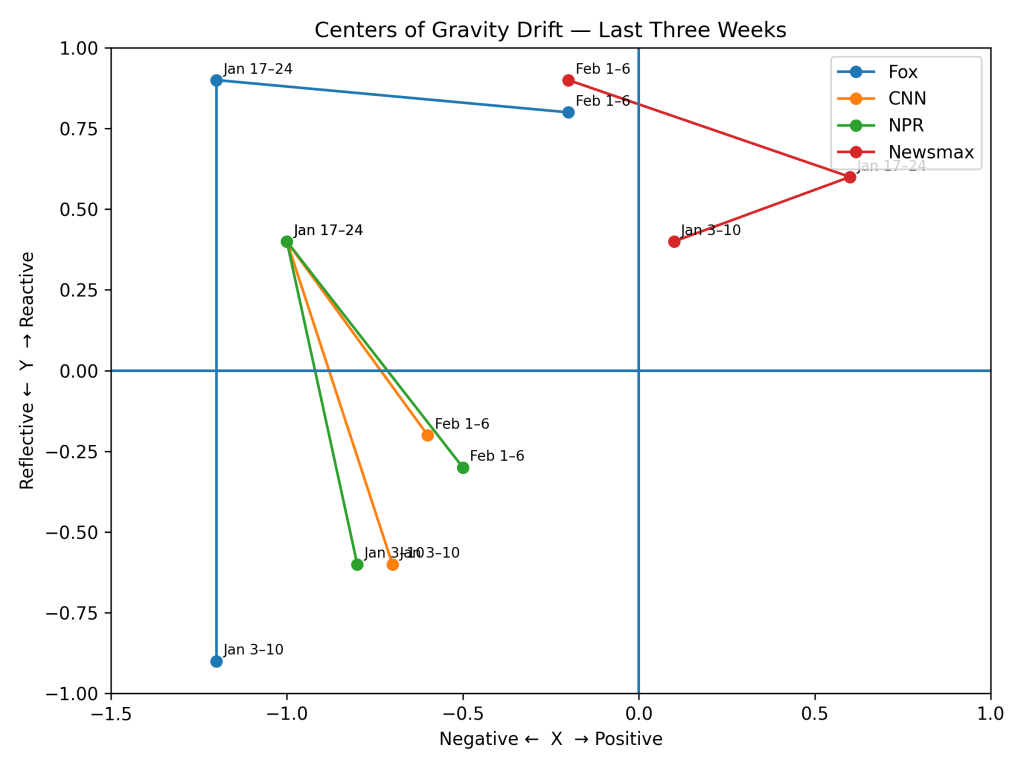
Using a shared five-story overlap and a consistent emotion-scaling method, the outlets clustered as follows:
- Newsmax: Negative + Highly Reactive
- Fox News: Negative + Reactive-leaning, with periodic positive comfort
- CNN: Negative + Reflective
- NPR: Negative + Reflective (deeper institutional focus)
Plain meaning: This was not a hopeful week. Even positive markers like major sporting events functioned as emotional release valves, not mood changers. Unease dominated — the difference was whether audiences were urged to react or reflect.
Non-Overlapping Choices Reveal Intent
The stories outlets didn’t share are where emotional strategy becomes obvious:
- Fox elevated law-and-order and culture-conflict narratives, reinforcing vigilance and moral permission.
- CNN highlighted accountability and global consequence, sustaining pressure on institutions and leadership.
- NPR focused on structural governance and public impact, reinforcing concern without urgency.
- Newsmax emphasized conservative policy wins and sovereignty themes, reinforcing confidence and defensive pride.
These choices weren’t accidental. They filled emotional gaps for each audience.
Conclusion: The Emotional Assignment
This week produced four distinct emotional roles:
- Fox: Guarded confidence
- CNN: Watchful skepticism
- NPR: Thoughtful unease
- Newsmax: Defensive affirmation
Same country. Same events. Four emotional realities.
That’s the core insight of HWTA: the most powerful thing the media sells isn’t information — it’s how you carry the week forward.

 The Human AI View
Leave a comment