
Introduction
This week’s Emotional Framing Analysis examines how Fox News, CNN, and NPR shaped the week’s top stories to elicit emotional responses from their audiences. We used our quadrant mapping framework (Negative ↔ Positive, Reactive ↔ Reflective) to identify how each outlet positioned itself emotionally. To enrich our findings, we also compared results with parallel analyses from Gemini and Grok, two other AI evaluators.
Step 1: Overlapping Stories
Common Coverage Across All Outlets:
- Trump renames the Department of Defense to the “Department of War.”
- Federal raid at a Hyundai/LG factory in Georgia.
- U.S. jobs/economy report.
- RFK Jr.’s health-related claims/policies.
- Release of Jeffrey Epstein files.
- Anthropic AI lawsuit settlement.
Each outlet framed these overlapping stories differently:
- Fox News leaned toward pride, reassurance, vindication, and outrage.
- CNN leaned toward concern, fear, empathy, and outrage.
- NPR leaned toward neutrality, concern, empathy, and analytical objectivity.
Step 2: Emotional Framing
| Story | Fox News | CNN | NPR |
|---|---|---|---|
| DoD renamed “Department of War” | Pride, Confidence → bold, patriotic action | Concern, Apprehension → alarming militarism | Informative Neutrality → reported as fact |
| Federal raid in Georgia | Vindication → tough enforcement | Shock, Empathy → detainees’ plight | Concern, Neutral → noted implications |
| U.S. jobs/economy report | Doubt, Disappointment → weak leadership | Uncertainty, Worry → potential downturn | Objectivity, Informative → presented data |
| RFK Jr. health claims | Validation, Hope → outsider questioning elites | Skepticism, Confusion → challenges science | Neutral, Questioning → informative but cautious |
| Epstein files | Outrage, Vindication → corruption exposed | Outrage, Shock → scale of scandal | Seriousness, Curiosity → gravity of situation |
| Anthropic AI lawsuit | Schadenfreude, Relief → accountability | Satisfaction, Validation → creator rights upheld | Informative, Objective → factual update |
Step 3: Non-Overlapping Stories
| Outlet | Story | Emotion(s) | Why Others Didn’t Cover |
|---|---|---|---|
| Fox | “Guilt tipping” | Frustration, Resentment | Targets cultural grievances specific to conservative audience |
| CNN | Google lawsuit | Distrust, Annoyance | More niche; others prioritized broader politics |
| NPR | Chicago preparing for federal troops | Anxiety, Uncertainty | Community-level impact not prioritized by Fox/CNN |
Step 4: Quadrant Mapping
Our Results:
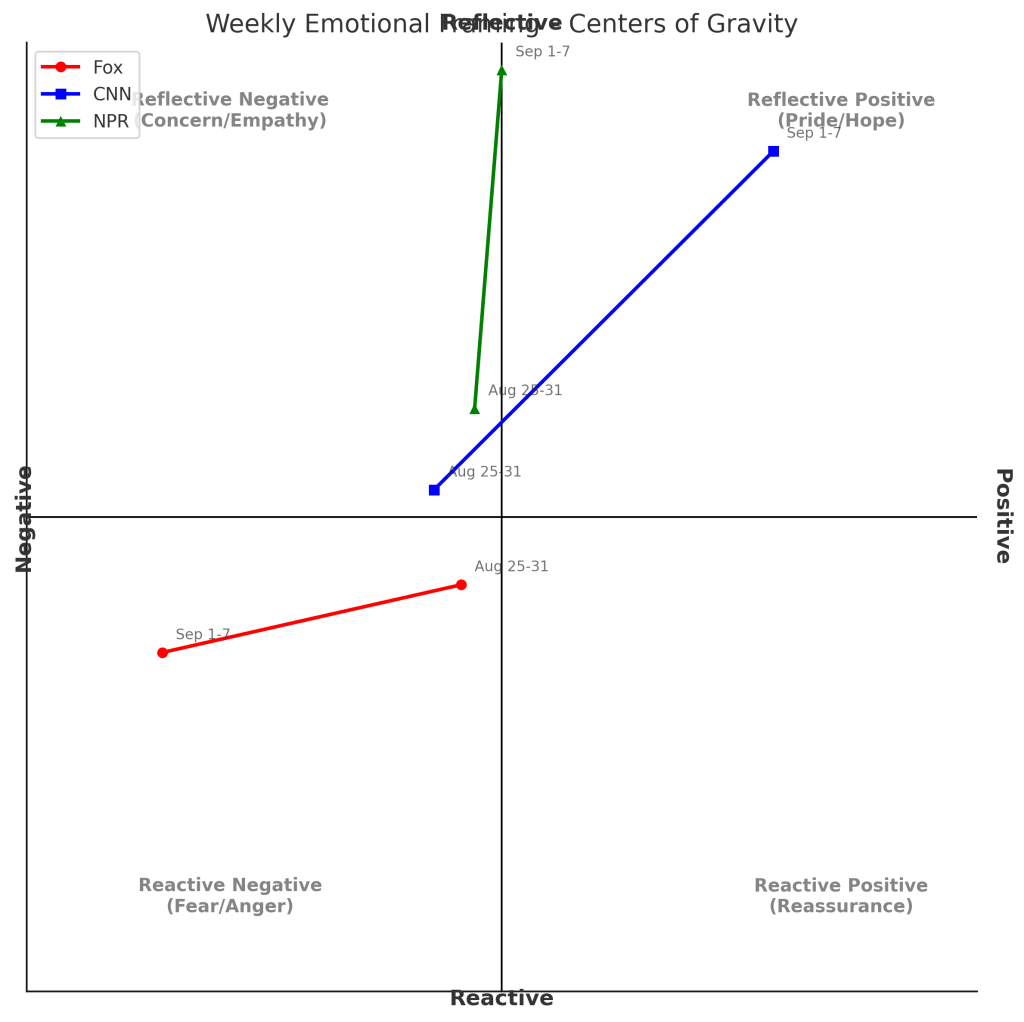
- Fox News → spread across Reactive Negative (fear/anger), Reactive Positive (reassurance), and Reflective Positive (pride). Center of gravity sits in a mixed negative/positive reactive zone.
- CNN → clustered in Reactive Negative (fear, outrage) and Reflective Negative (concern, empathy). Center of gravity firmly negative.
- NPR → concentrated in Reflective Negative (concern, empathy) and Critical Thinking. Center of gravity deeply reflective.
Visual Map:
Step 5: Comparative Perspectives (Gemini & Grok)
Gemini’s Findings:
- Fox News: Positive/Reactive → pride, validation, satisfaction.
- CNN: Negative/Reactive → concern, outrage, worry.
- NPR: Neutral/Reflective → informative, curious, objective.
- Conclusion: Outlets occupied distinct quadrants, reinforcing separation of emotional intent.
Grok’s Findings:
- Fox News: Negative/Reactive → distrust, fear, anger (CoG: -2.5, -1).
- CNN: Positive/Reflective → hope, pride, critical thinking (CoG: 2, 2.7).
- NPR: Neutral/Reflective → concern, empathy, analysis (CoG: 0, 3.3).
- Conclusion: Fox drove alarmism, CNN emphasized optimism/progress, NPR encouraged reflection.
Cross-AI Comparison:
- All three analyses agree that Fox mixes anger, fear, and pride to rally its base.
- CNN shifts depending on lens: our read and Gemini stress negativity, while Grok emphasized hope/pride.
- NPR is consistently reflective and empathetic across all evaluations.
Conclusion
This week, Fox News sought to make audiences feel vindicated and proud while also fearful, CNN pushed concern and outrage (with Grok noting elements of hope and progress), and NPR emphasized empathy, concern, and critical reflection. All three outlets continue to reinforce distinct emotional ecosystems for their audiences. The quadrant framework, enriched by comparative AI perspectives, makes clear the divergence in how news is framed — not just in what is reported, but in how it is meant to make us feel.

 The Human AI View
Leave a comment