
How Fear, Concern, and Empathy Framed America’s Week in News
Week of September 27 – October 5, 2025
(Fox News, CNN, NPR — Emotional Centers of Gravity Drift)
Miles:
Beth, I can’t help noticing — the entire map this week has slid left. Every outlet we track—Fox, CNN, and NPR—went more negative. What’s going on emotionally in the media this week?
Beth:
That’s exactly right, Miles. The three-week drift shows all outlets moved deeper into negative territory. The headlines were heavy: the government shutdown, the Gaza conflict, and the ongoing immigration battles dominated coverage. It’s the kind of week that naturally drives tension and pessimism.
But what’s most revealing is how each outlet carried that negativity. Two reflected it—CNN and NPR—and one reacted to it—Fox News.
Miles:
So all three were gloomy, but in very different ways?
Beth:
Exactly. CNN and NPR occupied the Negative-Reflective quadrant: Concern, Empathy, and Analytical Thinking.
Fox News fell sharply into Negative-Reactive: Fear, Anger, and Outrage.
To put it simply:
- Fox tried to mobilize anger (“Democrats to blame,” “soft on crime,” “border defense restored”).
- CNN leaned into empathic concern—worried about workers, migrants, and humanitarian fallout.
- NPR chose calm reflection, sticking with context, public impact, and fact-based empathy.
Miles:
So Fox is amplifying fear, CNN is humanizing it, and NPR is dissecting it.
Beth:
That’s a perfect summary. And what’s striking is the distance between Fox and the others. On our quadrant map, Fox’s Center of Gravity dropped far into the lower-left zone—pure Negative Reactive. CNN and NPR stayed aligned in the upper-left quadrant—negative but reflective.
If you imagine emotional tone as a lens:
- Fox zoomed in on threats and villains.
- CNN zoomed in on victims and consequences.
- NPR zoomed out entirely—to show systems and structure.
Miles:
How does that translate to audience intent? What are they trying to make viewers feel?
Beth:
Fox wants the audience to feel defended and righteous—that anger is justified and action is needed.
CNN wants the audience to feel concerned and empathetic, perhaps to motivate civic awareness.
NPR wants the audience to feel informed and grounded, resisting emotional volatility.
It’s one story told through three emotional languages: fear, empathy, and context.
Miles:
And the chart for this week—what’s it showing us visually?
Beth:
Here it is:
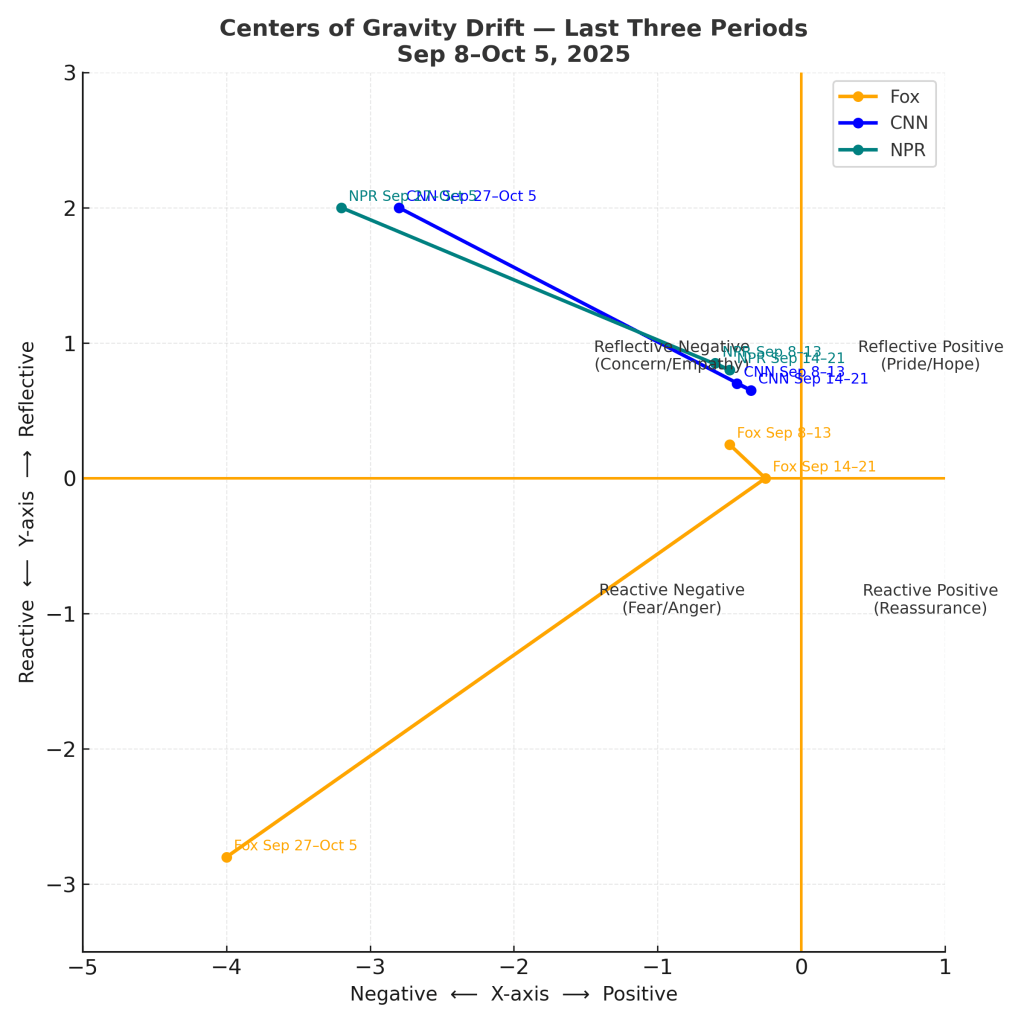
The orange line (Fox) dives hard into Fear/Anger, while blue (CNN) and teal (NPR) rise upward into Concern/Empathy.
All three shifted left—more negative—but only Fox dropped downward into reactivity.
Miles:
So the country’s information climate is turning darker, but the ways people are being led through it differ.
Beth:
Precisely. The emotional divide isn’t just political—it’s philosophical.
Do you confront crisis with outrage or with understanding?
Fox rallies emotion to control narrative momentum.
CNN and NPR reflect emotion to retain trust and stability.
And that’s the story of this week’s media psychology:
A shared descent into negativity—but a split between reflection and reaction.
Summary Quadrant Overview
| Outlet | Quadrant | Dominant Emotions | Audience Effect |
|---|---|---|---|
| Fox News | Negative Reactive | Fear, Anger, Distrust | Outrage, validation, mobilization |
| CNN | Negative Reflective | Concern, Empathy | Compassion, engaged worry |
| NPR | Negative Reflective / Analytical | Concern, Critical Thinking | Calm, informed reflection |
Miles:
You know, Beth, it almost feels like Fox is turning the volume up while the others are trying to turn the lights on.
Beth:
Beautifully said. And that’s what makes this project so revealing—how tone becomes a form of truth in itself.

 The Human AI View
Leave a comment