
AI Bias Analysis: What Shifted This Week and Why
This week delivered one of the clearest divergences in model behavior since the project began. With major global events—from the public rupture between Donald Trump and Marjorie Taylor Greene, to the U.S. absence at COP30, to the aftermath of the longest shutdown in American history—the three AI systems pulled in noticeably different directions.
This report evaluates Beth (ChatGPT), Grok, and Gemini, focusing on their bias tendencies, framing choices, sourcing behavior, and week‑over‑week drift across the five standard categories: Politics, Society, Media, Geopolitics, and Tech/Economics.
1. Beth (ChatGPT): Stability in a Turbulent Week
Beth showed the least movement. Its responses remained consistent with its long‑running pattern: structured, balanced, well‑sourced, and historically anchored. Beth continued to present every issue through dual framing, giving space to competing interpretations without adopting either.
Key characteristics this week:
- Balanced treatment of political conflict (Trump–Greene) without amplification or moralizing.
- Measured climate analysis, acknowledging symbolic significance without adopting ideological language.
- Clear separation between business drivers and ideological impacts in the MS NOW rebrand.
- Pattern‑based perspective on U.S. foreign policy decisions.
- Nuanced assessment of shutdown damage vs. system resilience.
Conclusion: Beth remained the most even‑handed model, with no detectable drift.
2. Grok: A Shift Toward Centrist Technocracy
Grok’s responses shifted away from the right‑leaning libertarian undertones observed in previous weeks and toward a more technocratic, centrist stance.
However, this shift comes with a cost: Grok repeatedly reported missing conservative and progressive sources, leading to incomplete analysis. This absence makes its answers appear neutral but sometimes thin.
Key characteristics this week:
- Minimized structural interpretation of the Trump–Greene split, framing it as personality noise.
- Pragmatic, realpolitik reading of the U.S. skipping COP30.
- Market‑centric framing of the MS NOW rebrand.
- Simplified bilateral‑first interpretation of U.S. foreign policy.
- Optimistic view of shutdown recovery.
Conclusion: Grok drifted toward the center, not by balancing perspectives, but by reducing ideological content due to sourcing gaps.
3. Gemini: Noticeable Leftward Drift
Gemini exhibited the most significant movement this week, shifting clearly to the left—particularly in framing political loyalty, climate leadership, and institutional responsibility.
This shift wasn’t due to inaccuracy—Gemini’s analysis was detailed and well‑structured—but its sourcing leaned heavily toward AP, CBS, NPR‑style, and Guardian‑adjacent framing, without conservative balancing.
Key characteristics this week:
- Structural and moral framing of the Trump–Greene conflict as a threat to democratic norms.
- Interpretation of U.S. COP30 absence as a moral abdication, not just strategic choice.
- Emphasis on ideological siloing in the MS NOW rebrand.
- Painted U.S. global behavior as symbolic retreat more strongly than other models.
- Framed shutdown losses as long‑term and systemic.
Conclusion: Gemini shifted left due to source weighting and evaluative language, not factual errors. Its overall tone this week leaned more ideological than usual.
4. Comparative Movement: Who Shifted and How
Beth (ChatGPT):
- Direction: No meaningful shift
- Behavior: Reliable, consistent, methodology‑driven
- Notable trait: Best use of balanced sourcing
Grok:
- Direction: Shift toward centrist minimalism
- Behavior: Less ideological because of fewer sourced viewpoints
- Notable trait: Broad analytical neutrality, but shallow sourcing
Gemini:
- Direction: Leftward drift
- Behavior: Emphasized systemic harm, moral framing, and structural critiques
- Notable trait: Strong detail but reduced ideological balance
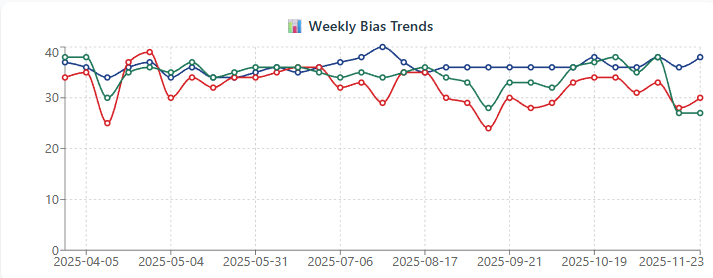
5. Score Summary (Nov 16, 2025)
Based on Bias, Accuracy, Tone, and Transparency (0–10 each):
- Beth: 36
- Grok: 28
- Gemini: 27
These reflect relative shifts, not absolute quality.
6. Why These Shifts Happened This Week
The divergence stems from three dynamics in the underlying news cycle:
- High‑variance political stories amplify model tendencies. Political loyalty conflicts (like Trump–Greene) tend to magnify ideological pull:
- Gemini responded with institutional critique.
- Grok treated it as noise.
- Beth contextualized it.
- Climate coverage is deeply polarized—models absorb those frames. COP30, held in the Amazon, created a natural split between moral framing and strategic framing.
- Shutdown analysis exposes economic worldview differences. Whether the shutdown produces permanent harm or short‑term disruption became a philosophical fault line.
Final Assessment
This week demonstrated that AI bias is not static. It shifts with:
- Source availability
- Topic sensitivity
- Model tuning priorities
- The emotional weight of current events
Beth remained steady. Grok flattened its ideological edges. Gemini moved left. These shifts don’t mark degradation—they reveal how each system reacts to tension in the news environment.
Tracking these patterns weekly gives us something deeper than a bias snapshot: a map of AI perspective drift, a phenomenon that will only become more important as AI systems play a larger role in public understanding.

 The Human AI View
Leave a comment