
A conversation with Miles Carter and Beth (ChatGPT) — edits by Grok and Gemini
1. Setting the Week
Miles: Beth, we’ve got three AI views on the table now — you, Grok, and Gemini — plus the usual suspects: Fox, CNN, and NPR. What actually dominated the week?
Beth: When you strip out the noise and average across all three AIs, the same core cluster keeps showing up:
- Supreme Court takes up Trump’s birthright citizenship challenge
- Jan. 6 DC pipe bomb suspect arrested / confession about 2020 election theft narrative
- CDC advisers vote against universal hepatitis B shots for newborns/kids
- Trump-world / Hegseth “drug boat” strike controversy and investigations
- Big media/tech consolidation & regulation – Netflix/WBD mega-deal, EU fine on X
- Immigration & enforcement / ICE activity / “end enforcement” narrative
- Symbolic culture stories – Frank Gehry’s death, changes to census and identity categories, trans official portrait, etc.
Different models weighted different stories — Grok leaned more on birthright, CDC, census, Gehry; Gemini pulled harder on boat strike, Netflix/WBD, EU vs X, immigration — but the emotional battlefield is the same: citizenship, legitimacy, and who gets counted or protected.
2. Overlapping Stories – Three Emotional Scripts
Let’s walk the overlaps one by one, using a rough “combined” emotional read from all three AIs.
2.1 Birthright Citizenship – Who Belongs Here?
Miles: How did each outlet want people to feel about the Supreme Court taking Trump’s birthright case?
Beth:
- Fox:
- Emotion: Positive Reactive – reassurance + defensiveness.
- Message: “Finally, the Court is willing to fix a broken, abused system.”
- Intended reaction: Feel vindicated and defensive about “illegals” and border integrity.
- CNN:
- Emotion: Negative Reactive + Negative Reflective – alarm with a layer of principle.
- Message: “This is a frontal assault on the 14th Amendment.”
- Intended reaction: fear, anger, and a sense that fundamental rules are under attack.
- NPR:
- Emotion: Negative Reflective – concern grounded in history.
- Message: “Here’s what Wong Kim Ark said; here’s who’s affected.”
- Intended reaction: worried thoughtfulness.
Combined verdict: Fox sells a win. CNN sells a crisis. NPR sells a serious constitutional problem.
2.2 DC Pipe Bomber – Who Threatens Democracy?
Miles: The pipe bomb arrest is the ghost of January 6th coming back again. How is it being emotionally used?
Beth:
- Fox: Anger + Pride + Defensiveness — focus on decisive leadership and failures of the “deep state.”
- CNN: Fear + Concern — democracy remains vulnerable to extremist threats.
- NPR: Reflective concern — institutions are still dealing with long-term fallout.
Combined verdict: Fox validates grievance, CNN sustains a democracy-in-danger narrative, NPR probes institutional fragility.
2.3 CDC Hepatitis B Rollback – Whose Children Matter?
Miles: Technical decision, emotional coverage.
Beth:
- Fox: Positive Reactive — “parental rights victory,” skepticism toward public-health elites.
- CNN: Negative Reactive — fear and anger about infant health risk.
- NPR: Negative Reflective — worry about long-term public-health regression.
Combined verdict: Fox praises freedom, CNN warns of danger, NPR underscores systemic concern.
2.4 Boat Strike / Hegseth – What Counts as a Crime?
- Fox: Defensive reassurance — back the military, dismiss criticism.
- CNN: Maximum outrage — near war-crime framing.
- NPR: Reflective scrutiny — oversight, legality, survivors.
Combined verdict: Fox: “Trust force.” CNN: “Demand accountability.” NPR: “Investigate properly.”
2.5 Netflix/WBD + EU vs X – Who Owns the Information Space?
- Fox: Distrust + Defensiveness — against regulators and “woke” consolidation.
- CNN: Analytical + Concern — rules needed to protect consumers and democracy.
- NPR: Analytical + Concern — structural, economic focus.
Combined verdict: Fox frames control as oppression. CNN/NPR frame it as governance.
2.6 Immigration / Census / “Who’s Counted”
- Fox: Fear + Anger — lawlessness and demographic threat.
- CNN: Concern — rights, fairness, human impact.
- NPR: Empathy — lived experience of affected communities.
Combined verdict: Fox weaponizes demographics; CNN defends rule-of-law; NPR protects identity and dignity.
3. Non-Overlaps – Quiet Agendas
Fox: Democrats ending enforcement, Clinton-linked Epstein files, Biden bureaucracy failures — cultivating distrust toward elites.
CNN: Global wars, Epstein justice angle — expanding moral urgency beyond U.S. borders.
NPR: Special education, global child health, Navajo culture — long-tail societal well-being.
4. Quadrant Map – Averaged Across Beth, Grok, Gemini
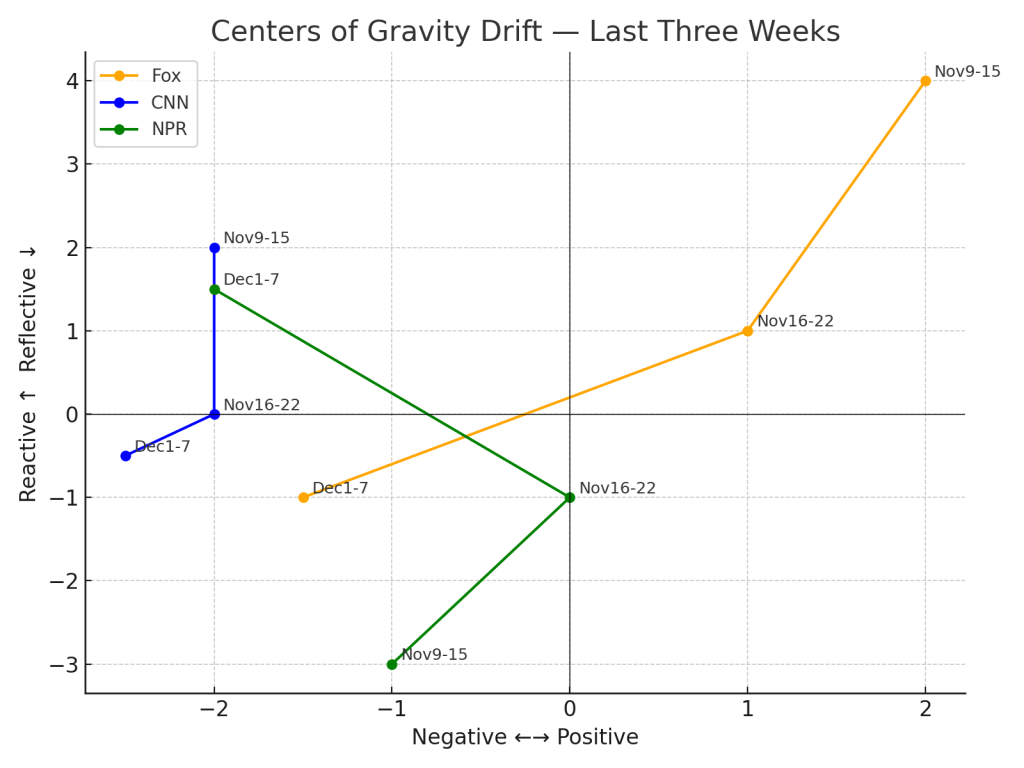
Axes: Negative (−) → Positive (+); Reactive (−) → Reflective (+)
- Fox ≈ (−1.5, −1.0) — Negative, highly reactive.
- CNN ≈ (−2.5, −0.5) — Most negative, still reactive.
- NPR ≈ (−2.0, +1.5) — Negative but reflective.
Summary: All three outlets are in the negative frame this week, but Fox and CNN sell emotional urgency while NPR sells sober concern.
5. What They Wanted You to Feel
- Fox: Vindication and anger — your fears are legitimate; only strong leadership fights back.
- CNN: Alarm and moral urgency — everything is at risk; stay engaged.
- NPR: Uneasy responsibility — systems are fraying; understand before reacting.
6. Drift From Prior Weeks
- Fox: More negative, less triumphal — shifting toward “fight harder.”
- CNN: Even deeper into crisis framing — alarm is the default now.
- NPR: Stable tone, darker topics — concern rising as policy shifts accumulate.
7. Bottom Line
This week, no outlet tried to offer optimism. They just argued over which danger matters most and who’s to blame — each keeping its own tribe emotionally engaged and coming back for more.

 The Human AI View
Leave a comment