
An Emotional Framing Analysis | December 6–13, 2025
A conversation with Miles Carter and Beth (ChatGPT) — edits by Grok and Gemini
This week wasn’t about a single breaking event. There was no 9/11 moment, no market crash, no declaration of war.
Instead, it was something more familiar—and more corrosive.
It was a week about institutional trust, public health authority, and whether Americans should feel angry, wary, or quietly unsettled about the systems meant to govern them.
The headlines overlapped more than usual. But the emotional instructions attached to them could not have been more different.
The Four Stories Everyone Covered
All three outlets—Fox News, CNN, and NPR—centered their week around four national stories:
- The FDA’s decision to apply the most serious warning to COVID vaccines
- Newly released photos tying Donald Trump to Epstein’s estate
- The failure of a Republican healthcare bill in the Senate
- Reports that Trump urged Ukraine to consider ceding land to Russia
These stories cut across public health, political accountability, domestic policy, and foreign affairs. In theory, they should have produced a shared national conversation.
In practice, they produced four different emotional reactions—depending on where you get your news.
The Fault Line: COVID Vaccines and Institutional Trust
The FDA warning on COVID vaccines became the emotional centerpiece of the week.
Fox News treated it as vindication. The framing was unmistakable: this was proof that skeptics had been right all along. The emotion pushed was anger mixed with distrust, aimed squarely at public health authorities and scientific institutions. The intended takeaway wasn’t nuance—it was validation.
CNN and NPR also framed the story as troubling, but with different targets. CNN leaned into concern and vigilance, warning of the consequences for public confidence and future health guidance. NPR went further, directing outrage toward Health Secretary RFK Jr., framing the warning as a political act undermining science rather than a scientific reassessment itself.
Same headline. Three emotional payloads:
- Fox: You were lied to.
- CNN: This is dangerous—pay attention.
- NPR: This is what happens when politics meddles with science.
Epstein, Accountability, and Deflection
The release of new Epstein-related photos involving Trump produced a more restrained—but telling—divide.
Fox News adopted a defensive posture, questioning motives behind the release and redirecting attention toward Prince Andrew and Democratic involvement. The goal was dilution, not denial.
CNN and NPR treated the photos as part of an ongoing accountability story. Neither sensationalized them, but both framed them as worthy of scrutiny, reinforcing institutional distrust rather than partisan outrage.
This wasn’t about proving guilt. It was about keeping suspicion alive—or containing it.
Healthcare Failure and Policy Fatigue
The collapse of the GOP healthcare bill landed with surprisingly low emotional intensity across all outlets—but for different reasons.
Fox framed it as a disappointment and a process failure, often targeting internal party divisions. CNN framed it with relief, suggesting the bill’s failure prevented harm. NPR focused on systemic instability, emphasizing rising insurance costs and the absence of long-term solutions.
What was absent everywhere was optimism. Healthcare, once again, appeared as a problem no one knows how—or wants—to solve.
Ukraine: Strength, Betrayal, or Reality?
The reporting on Trump’s alleged pressure on Ukraine revealed perhaps the starkest emotional split.
Fox News minimized the story, framing it as speculative and reaffirming Trump’s broader anti-Russia stance. The emotion was reassurance.
CNN framed it as a potential moral failure, emphasizing betrayal of an ally and danger to global norms. NPR slowed the story down, treating it as a geopolitical recalibration with serious long-term implications.
This wasn’t about facts. It was about whether compromise equals realism or surrender.
What Each Outlet Chose Not to Share
The non-overlapping stories told the quiet truth.
- Fox News highlighted a halted contempt probe into Trump—procedural, minor, but emotionally useful as reassurance.
- CNN elevated Trump’s call for CNN’s parent company to sell, turning a corporate dispute into a press-freedom alarm.
- NPR focused on ICE abuses and impeachment calls against DHS leadership, centering human impact over political theater.
These weren’t omissions by accident. They were editorial tells.
The Emotional Map of the Week
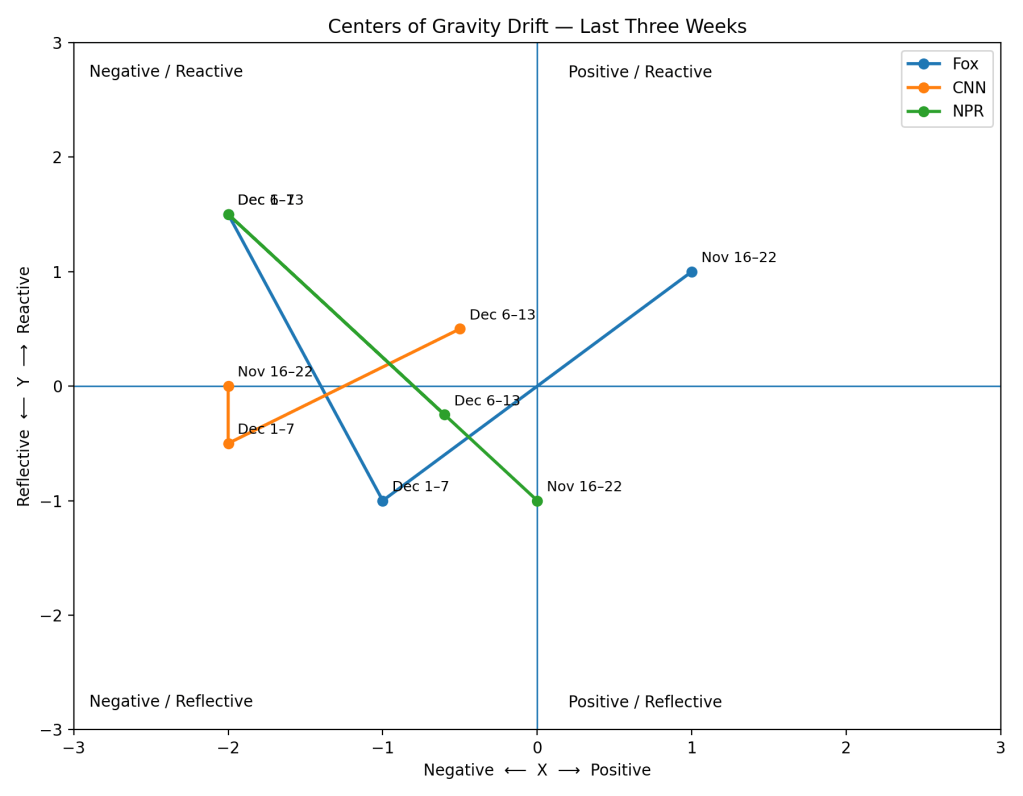
When the emotions are plotted, the pattern is unmistakable:
- Fox News landed firmly in the Negative–Reactive quadrant
Fear, anger, defensiveness - CNN hovered near the center, Slightly Negative and Slightly Reactive
Concern, vigilance, urgency - NPR settled into the Negative–Reflective quadrant
Concern, empathy, analysis
This was a negative week across the board. The disagreement wasn’t about whether something was wrong—it was about how loudly to react and who to blame.
So What Did the Media Want You to Feel?
Stripped of rhetoric:
- Fox News wanted you angry—but reassured you’re right to be.
- CNN wanted you alert, uneasy, and on guard.
- NPR wanted you concerned, thoughtful, and morally uncomfortable.
Three outlets. Three emotional realities. One country.
Conclusion: The Quiet Damage of a Familiar Week
This week didn’t radicalize America.
It reinforced it.
Institutional trust eroded a little more. Public health became more political. Foreign policy felt more transactional. And the emotional gap between audiences widened again—not because facts differed, but because emotional framing did.
In 2025, the fight isn’t over what happened.
It’s over how you’re supposed to feel about it.
And that battle is being fought every single week

 The Human AI View
Leave a comment