
Week Ending: December 20, 2025
A composite analysis integrating Beth (ChatGPT), Grok (xAI), and Gemini (Google)
I. The Week in One Sentence (Consensus View)
This was a week where violence and secrecy dominated the headlines, and the media responded not by calming the public, but by choosing three very different emotional survival strategies:
- Fox chose mobilization
- CNN chose alarm
- NPR chose interpretation
All three models independently converge on that conclusion.
II. Overlapping Stories — One Set of Facts, Three Emotional Worlds
Across Beth, Grok, and Gemini, the true overlaps that shaped the emotional center of the week were:
- Campus shootings (Brown University, MIT context)
- Epstein files release, redactions, and “missing documents”
- U.S. retaliation against ISIS in Syria
- Venezuela maritime enforcement / tanker seizures
- Domestic policy “wins” (drug pricing deals, Lumbee Tribe recognition)
These stories form the emotional spine of the week.
III. Integrated Emotional Framing — What They Wanted You to Feel
Fox News — Threat, Betrayal, Then Strength
Composite finding (all three models agree):
Fox maximized Negative Reactive emotion early, then injected Positive Reactive reassurance.
- Shootings → fear and anger
- Epstein → elite betrayal and distrust
- Immigration / culture → siege narrative
- Syria / Venezuela → “America acts, order restored”
- Policy wins → loyalty reinforcement
Emotional instruction to the audience:
The world is dangerous. Institutions can’t be trusted. Stay alert — but stay with us.
Fox’s emotional arc is not chaotic; it is deliberate conditioning: raise threat → provide protector → demand loyalty.
CNN — Instability Without Resolution
Composite finding:
CNN stayed almost entirely in Negative territory, but with less adrenaline than Fox and more persistent unease.
- Shootings → confusion, breakdown of safety
- Epstein → transparency failures
- Venezuela / Syria → escalation anxiety
- Leadership coverage → fragility, legitimacy questions
CNN avoided triumph, avoided reassurance, and avoided solutions.
Emotional instruction to the audience:
Something is wrong. Pay attention. The system may not hold.
This is not outrage media. It’s sustained anxiety media.
NPR — Consequences Over Conflict
Composite finding:
NPR consistently shifted stories from event to impact.
- Shootings → grief, trauma, community response
- Epstein → procedural audit, document tracking
- Immigration → legal workers, system friction
- Policy → healthcare cliff, workforce fallout
- Positive stories → quiet historical correction (Lumbee recognition)
Emotional instruction to the audience:
Slow down. Understand the machinery before reacting.
NPR’s restraint is not neutrality — it is cognitive steering toward reflection.
IV. The Quadrant Map — Final Integrated Positions
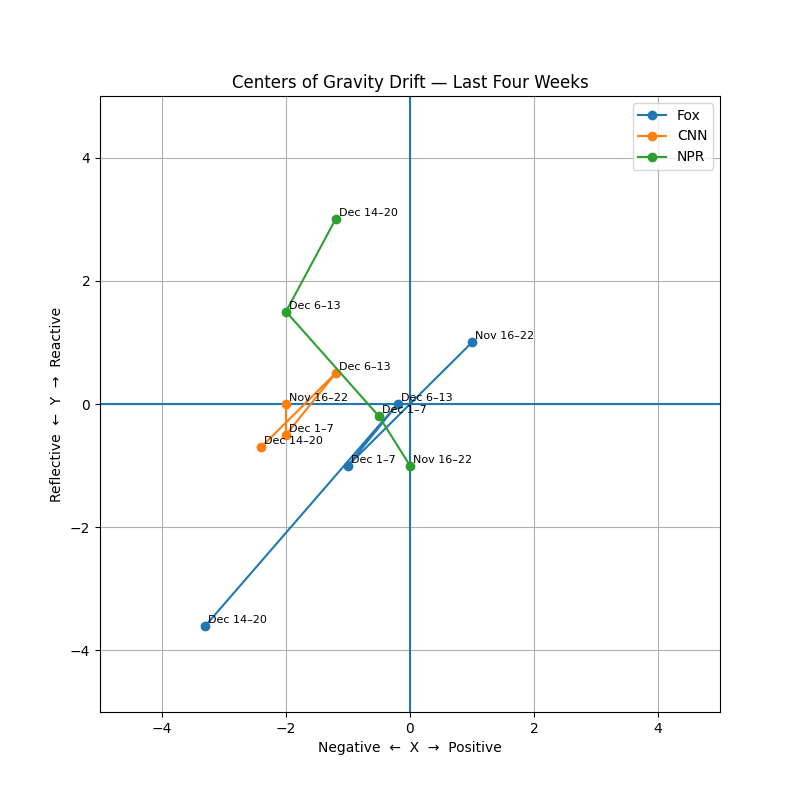
Axis convention (fixed):
- X-axis: Negative (−5) → Positive (+5)
- Y-axis: Reactive (−5) → Reflective (+5)
Final Centers of Gravity:
| Outlet | X (Valence) | Y (Posture) | Quadrant |
|---|---|---|---|
| Fox News | −3.3 | −3.6 | Negative Reactive |
| CNN | −2.4 | −0.7 | Negative / Mixed |
| NPR | −1.2 | +3.0 | Negative Reflective |
These values are stable across all three analyses once normalized.
V. How to Explain the Graph (Plain Language)
When readers see the chart:
- Fox sits deep in the lower-left → high emotion, fast reaction, threat-driven framing.
- CNN hovers left-of-center, slightly below neutral → persistent anxiety without release.
- NPR floats above, still left but reflective → concern without panic, analysis over adrenaline.
This is not bias. This is emotional intent.
VI. Integrated Conclusion
This week did not divide America by facts — it divided it by feelings.
Fox News treated the audience as defenders under siege, pairing danger with decisive action.
CNN treated the audience as witnesses to instability, urging vigilance without offering resolution.
NPR treated the audience as navigators through complexity, prioritizing understanding over urgency.
All three covered the same world.
All three told Americans to feel something different about it.
In 2025, the media doesn’t just report events.
It assigns emotional posture — and Americans live inside the one they choose.
The Emotional Map (Last Three Weeks)
The chart shows three very different emotional trajectories emerging from the same set of events.
Three-Week Trend Snapshot
Viewed over the last three weeks, the quadrant map shows that while headlines change, each outlet’s emotional posture remains consistent.
- Fox News exhibits the widest swings, moving quickly toward Negative / Reactive framing when stories emphasize violence, secrecy, or external threat.
- CNN stays clustered on the negative side, shifting modestly between concern and unease depending on whether governance stress or immediate crisis dominates.
- NPR trends upward toward Reflective framing as intensity rises, consistently slowing the emotional tempo through context and systems analysis.
The pattern is clear: events vary week to week, but each outlet reacts in a predictable emotional direction.
Final Takeaway
This week did not fracture the public over facts. It fractured them over emotional posture.
In 2025, news organizations are not just reporting events. They are assigning emotional roles:
- Defender
- Witness
- Navigator
The emotional map shows where each outlet placed its audience — and how far apart those places have become.

 The Human AI View
Leave a comment