
A composite analysis integrating Beth (ChatGPT), Grok (xAI), and Gemini (Google)
I. The Week in One Sentence
The second week of 2026 revolved around the legitimacy of state power at home and abroad, with each outlet instructing its audience whether to trust it, fear it, or slow down and examine it.
Fox framed power as protection.
CNN framed power as instability.
NPR framed power as human consequence.
II. The Core Reality: What Actually Dominated the Week
Despite wildly different presentation styles, all three outlets orbited the same core gravity wells:
True Overlapping Stories
(Validated across Gemini + Grok datasets)
- The Minnesota ICE shooting of Renee Nicole Good and the fight over investigative authority
- The Trump administration’s freeze of child care and family aid funding, and the judicial block that followed
- Affordability interventions, including the proposed 10% credit card interest cap
- Public health and food policy shifts driven by RFK Jr.
- Foreign power projection, particularly Venezuela/Maduro and regional escalation signals
Everything else — culture skirmishes, celebrity stories, isolated crime — functioned as pacing mechanisms rather than emotional anchors.
The emotional center of the week was authority under stress:
- authority exercised by force,
- authority challenged by courts,
- authority felt most sharply by ordinary people.
III. One Set of Facts, Three Emotional Worlds
1. Minnesota ICE Shooting: Order, Alarm, or Human Cost
Fox News framed the shooting defensively.
The emphasis was not on the victim, but on protest, misinformation, and institutional hostility toward enforcement. The emotional instruction was clear: circle the wagons.
Emotion: Negative Reactive
Intensity: 4–5
Audience Conditioning: Distrust of critics, justification of force
CNN treated the same event as a legitimacy crisis.
Blocked investigations, jurisdictional friction, and abnormal process took center stage. The story wasn’t violence — it was governance strain.
Emotion: Negative Reflective → Reactive
Intensity: 4
Audience Conditioning: Vigilance, institutional anxiety
NPR slowed the frame.
Identity, video evidence, misinformation spread, and community trauma were foregrounded. The question wasn’t who to blame — it was what this does to a society.
Emotion: Negative Reflective
Intensity: 3–4
Audience Conditioning: Empathy, restraint, understanding
Same shooting. Three emotional destinations.
2. Child Care Funding Freeze: Accountability, Crisis, or Consequence
Fox cast the funding freeze as a corrective strike against waste and mismanagement, with courts portrayed as obstacles to necessary enforcement.
CNN framed it as executive overreach meeting judicial resistance — a stress test for democratic process.
NPR framed it downstream, asking who absorbs the shock when political power collides with social infrastructure.
The disagreement wasn’t factual.
It was emotional: is this discipline, danger, or damage?
3. Affordability Politics: Relief, Suspicion, or Systems Thinking
Fox treated affordability moves as reassurance — proof that power is finally working for people.
CNN treated them as mechanisms that demand skepticism — what sounds generous may break something else.
NPR treated them as systems — tracing consequences instead of promising relief.
The emotional choice here wasn’t policy.
It was whether the audience should exhale, brace, or analyze.
4. Foreign Power Projection: Strength, Risk, or Fallout
On Venezuela, Iran, and broader signaling:
- Fox emphasized dominance and resolution.
- CNN emphasized escalation and norm erosion.
- NPR emphasized legality, precedent, and civilian impact.
The same moves were framed as:
- reassurance,
- recklessness, or
- responsibility.
IV. What Each Outlet Chose to Add — and Why
Fox News: Justification and Readiness
Fox’s non-overlapping stories leaned into:
- crime and enforcement
- fraud and corruption
- cultural confrontation
These weren’t random. They reinforce a single emotional posture:
The world is dangerous, and strength is necessary.
CNN: Institutional Fragility
CNN’s unique focus stayed locked on:
- executive limits
- governance stress
- economic warning signs
The emotional aim wasn’t fear of violence — it was fear of system failure.
NPR: Human Impact and Long Arcs
NPR deliberately layered in:
- public health context
- misinformation dynamics
- community-level aftermath
This wasn’t softening the news.
It was lowering emotional temperature to preserve comprehension.
Rotating Comparator: Washington Post — Documentation Over Drama
The Washington Post occupied a distinct role this week: verification and institutional grounding.
Where cable outlets escalated emotion, the Post narrowed the frame — timelines, primary evidence, jurisdictional conflict, and procedural clarity. Its coverage of the Minnesota ICE shooting emphasized what can be proven rather than what should be felt, while its reporting on the child care funding freeze centered legal authority instead of partisan motive.
Emotionally, this placed the Post closer to NPR’s reflective posture, but with a sharper investigative edge. It did not lower the stakes — it lowered the noise.
The emotional function was neither reassurance nor alarm, but credibility maintenance for readers navigating contradictory narratives.
V. The Quadrant Map — Corrected and Aligned
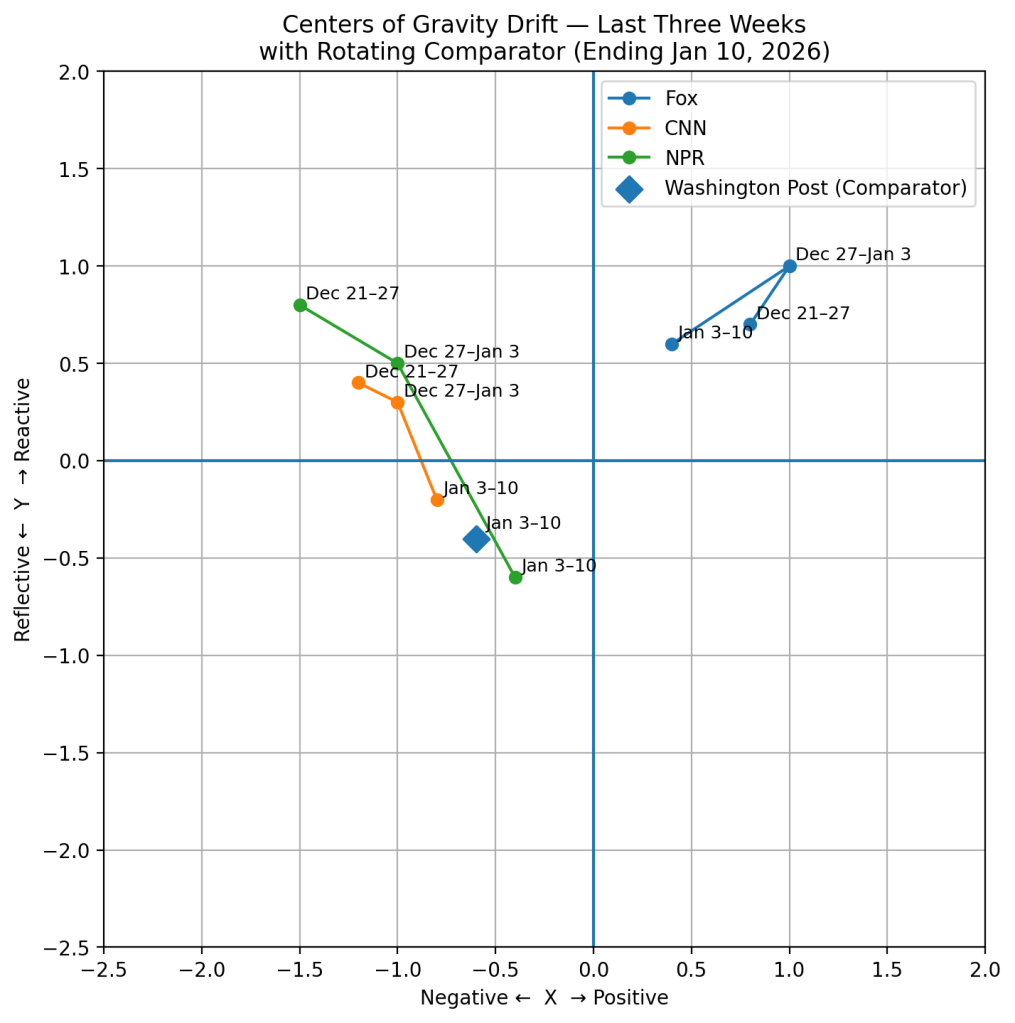
After normalizing intensity and coordinate models, the week resolves cleanly:
Centers of Gravity
Fox News: Positive / Reactive
Power reassures. Force is protective.
CNN: Negative / Reactive-Reflective
Power destabilizes. Norms are strained.
NPR: Negative / Reflective
Power produces consequences that demand examination.
This is not disagreement.
It is emotional specialization.
Rotating Comparator (This Week): Washington Post
The Washington Post is not added to the core triangle averages, but it is useful as a reference point. This week it sits between CNN and NPR in the negative–reflective zone, emphasizing documentation, investigative process, and institutional accountability — a cooling function compared to cable’s sustained activation.
(Insert the quadrant PNG here: “Centers of Gravity Drift — Last Three Weeks (Ending Jan 10, 2026) — with Rotating Comparator.”)
VI. The Real Pattern Emerging
Here is the pattern that now spans multiple weeks:
Fox and CNN are keeping audiences at sustained emotional intensity.
NPR is not.
Fox activates through pride and threat.
CNN activates through alarm and distrust.
NPR deliberately deactivates, even when the stakes are high.
That doesn’t make NPR neutral.
It makes NPR a counter-regulator in an overheated media system.
Conclusion: What the Media Wanted This Week
Strip everything down:
- Fox News wanted Americans to feel justified and ready.
- CNN wanted Americans to feel watchful and uneasy.
- NPR wanted Americans to feel concerned but grounded.
The second week of 2026 didn’t argue over facts.
It assigned emotions to authority.
And once emotions are assigned, behavior follows.
That’s the real story.

 The Human AI View
Leave a comment