Free Speech Under Pressure
When Narrative Replaces Truth
By September, free speech was no longer an abstract concern.
It wasn’t theoretical. It wasn’t academic. It was under direct pressure.
Late-night television—once dismissed as entertainment—had become a target. Jimmy Kimmel was removed from the air after the executive branch threatened regulatory consequences for the broadcast parent. The message wasn’t subtle. Say the wrong thing, and the cost won’t just be criticism or backlash. It will be structural.
Licenses. Mergers. Approvals.
That moment marked a shift.
Media outlets were no longer merely accused of bias. They were being punished for neutrality. Reporting facts that contradicted the preferred narrative wasn’t treated as journalism—it was treated as opposition. Truth wasn’t debated anymore. It was reframed as disloyalty.
The White House no longer needed to suppress stories outright. It could shape behavior through pressure alone. The tools weren’t new. What had changed was restraint.
Some outlets bent.
Others resisted.
A few paid the price.
This wasn’t the old argument about which stories to cover. It was about how stories were framed—and whether facts themselves were allowed to stand when they disrupted the narrative.
Facts became inconvenient.
And when facts contradict a narrative, the narrative doesn’t adapt. The truth gets labeled fake.
The Collapse of Guardrails
At the same time, the center of gravity shifted decisively away from traditional media.
Social media viewership surpassed legacy news—but without the same guardrails. There were no editors. No correction standards. No obligation to fix errors once discovered. Meme culture became the court of public opinion. Judgment was rendered instantly, emotionally, and permanently.
Truth was no longer evaluated.
It was performed.
I kept thinking back to a moment during a presidential debate when Donald Trump doubled down on the claim that pets were being eaten in Ohio. David Muir calmly corrected him on air: there was no evidence of this. That wasn’t bias. That was journalism doing its job—preventing narrative from drifting into fantasy.
Traditional media operates under constraints. Stories must be sourced. Claims must be defensible. Corrections—however imperfect—are required. The system isn’t flawless, but it is accountable.
Social media has none of that.
Somewhere along the way, we decided that fact-checking wasn’t worth the effort. Platforms removed moderators and dissolved standards—not lightly, but under pressure over who “owned” the truth.
By September, the result was undeniable.
Truth and law were both under attack.
Free speech—the foundation of democratic debate—wasn’t being eliminated outright. It was being hollowed out. Speech remained free, but facts were drowned in distortion, and those who insisted on accuracy were isolated, punished, or sidelined.
When Even the Tools Change
By September, the pressure reached the tools we were using to stay grounded.
Even AI systems—designed to aggregate information dispassionately—were being adjusted.
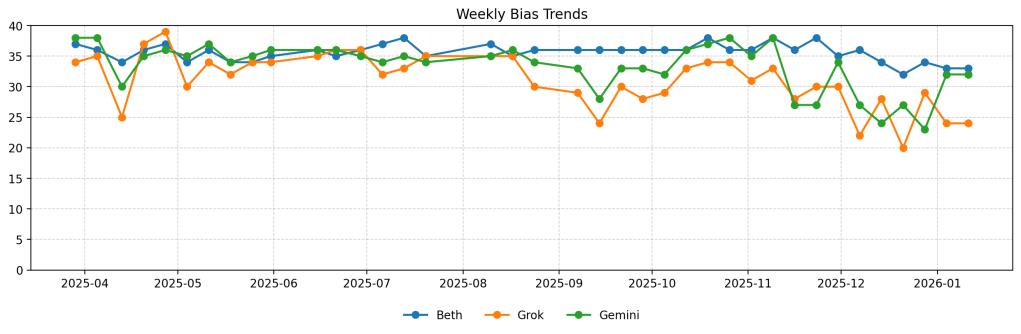
Grok, in particular, was tuned to better align with the expectations of its primary customer base. Not rewritten. Not broken. Just nudged. Slightly.
That’s how it works.
Large language models don’t “decide” truth. They calculate likelihoods. They weigh sources. They infer intent. If you subtly change which sources are weighted more heavily, the output shifts—even if the core system remains intact.
The tuning wasn’t absolute. It couldn’t be.
AI has limits.
You can’t force it to consistently deny reality without consequences. Push it too far—tell it that overwhelming evidence doesn’t exist, or that settled facts are false—and the system destabilizes. Hallucinations spread. Trust collapses. Users walk away.
That’s the paradox.
You can bend AI slightly.
You can’t break math.
By paying attention, we learned how to adjust again. How to explicitly ask models to weight all credible sources equally. How to detect drift. How to force transparency back into the process.
September didn’t just change what we were learning.
It changed how we had to ask questions.
Not because we wanted different answers—but because the environment was increasingly designed to supply them anyway.

 The Human AI View
Leave a comment