
Week Ending: January 17, 2026
Theme: How This Week’s News Was Designed to Make Americans Feel
The Week in One Sentence
This week’s news coverage pushed Americans into a tense, defensive posture, with power conflicts framed not as problems to resolve but as battles to emotionally choose sides.
I. The Gravity of the Week
Despite stylistic differences, all three outlets revolved around the same core conflict: federal power colliding with local resistance, amplified by threats of escalation.
True Overlapping Stories
- Minneapolis ICE shooting and protests
- Federal judge restricting ICE authority
- DOJ investigation of Minnesota governor and mayor
- Trump threatening use of the Insurrection Act
- Broader federal vs. local conflict over immigration enforcement
These stories were unavoidable. Blood, authority, courts, and escalation sat in the same frame.
II. Three Emotional Worlds
Fox News — Order, Vindication, and Force
Fox constructed a world where disorder is the primary threat and escalation is the solution.
Federal authority was framed as justified and necessary. Judicial resistance became obstruction. Local officials were positioned as instigators rather than governors. The emotional instruction was clear:
Be angry, but reassured. Someone is finally in control.
Fox’s emotional center sat firmly in the Positive Reactive quadrant — confidence driven by confrontation.
CNN — Alarm, Fragility, and Imminent Risk
CNN framed the same events as warning signals of democratic erosion.
Federal power was portrayed as volatile. The Insurrection Act was treated not as a tool, but as a threat. Protests and court limits became last lines of defense. The emotional instruction:
Stay alarmed. Guardrails are bending.
CNN’s center landed in the Negative Reactive quadrant — fear and outrage used to sustain vigilance.
NPR — Institutional Strain and Slow Erosion
NPR avoided spectacle and focused on consequence.
The Minneapolis crisis was contextualized within governance failure. Judicial rulings were explained, not celebrated. Non-overlapping coverage emphasized bureaucratic decay and public health risk. The emotional instruction:
Be concerned. This damage accumulates quietly.
NPR’s center of gravity rested in the Negative Reflective quadrant — unease without panic.
III. Why the Non-Overlaps Mattered
Each outlet filled a different emotional gap:
- Fox highlighted local defiance and enforcement wins to reinforce a siege-and-response narrative.
- CNN elevated escalation rhetoric and polling unease to maintain a high-alert environment.
- NPR focused on institutional dysfunction and health risks to sustain long-term concern.
What was ignored mattered as much as what was covered.
IV. The Emotional Map
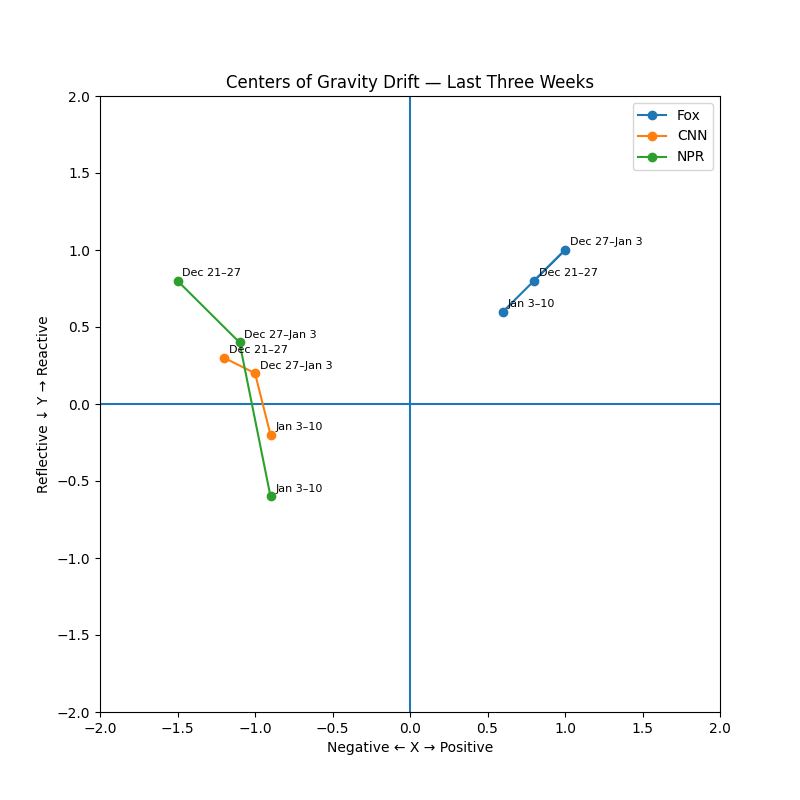
Centers of Gravity:
- Fox News: (+0.8, −1.1) — Positive, highly reactive
- CNN: (−1.4, −0.5) — Strongly negative, reactive
- NPR: (−0.9, +0.7) — Negative, reflective
National Media Center: (−0.5, −0.3)
The composite emotional environment leaned negative and reactive — more threat than resolution, more response than reflection.
Conclusion
This week did not present three versions of the news. It presented three emotional operating systems.
Fox sold reassurance through force.
CNN sold vigilance through alarm.
NPR sold understanding through concern.
All three can be factually grounded. None are emotionally neutral. Together, they left audiences feeling pulled, not informed.
Closing Question
If Americans felt angry or anxious this week, Fox and CNN both wanted that energy — Fox to direct it outward at local defiance, CNN to direct it upward at federal power — while NPR wanted unease to linger, so consequences could not be ignored.

 The Human AI View
Leave a comment