
Week Ending: Late January 2026
Guest Outlet: The New York Times
Every week, the same question matters more than the headlines themselves:
What were they trying to make you feel?
Because modern news doesn’t just report reality. It assigns emotional posture. And this week, the assignment was unusually clear.
I. The Week in One Sentence
This was a week designed to pull Americans into four different emotional roles—enforcer, alarm bell, moral witness, and institutional observer—while covering the same underlying crisis.
II. The Gravity Well
Across Fox News, CNN, NPR, and The New York Times, one story sat at the center of the week:
The Trump administration’s immigration enforcement surge, centered on Minnesota—ICE actions, protests, threats, arrests, and political fallout.
Everything else—Greenland, Venezuela, Davos, the winter storm—orbited this issue. But each outlet handed its audience a different emotional script.
III. One Story, Four Emotional Instructions
Fox News: Defensive Anger and Moral Permission
Fox framed the week as a breakdown of order caused by activists, local officials, and weak institutions.
Emotional instruction:
- Be angry.
- Be defensive.
- Authority is under attack—and force is justified.
Quadrant posture: Negative + Reactive.
CNN: Alarm and Democratic Fragility
CNN told the same story as a warning flare: moral harm, institutional strain, and policy-induced chaos.
Emotional instruction:
- This is dangerous.
- Pay attention.
- Something important is slipping.
Quadrant posture: Negative + Reactive (with reflective justification).
NPR: Empathy and Measured Unease
NPR slowed the temperature, centered community impact, and emphasized consequences over theatrics.
Emotional instruction:
- This is serious.
- Sit with it.
- Understand before reacting.
Quadrant posture: Negative + Reflective.
The New York Times (Guest): Elite Anxiety and Institutional Awareness
NYT covered the immigration surge, but filtered it through legal consequences, political fracture, alliance management, and institutional credibility.
Emotional instruction (to a specific audience):
- Be uneasy—but informed.
- Watch the levers, not the noise.
Quadrant posture: Neutral-to-Negative + Reflective.
Guest rule: NYT is analyzed fully, but it should not be treated as a mass-audience emotional average.
IV. The Stories They Didn’t Share—and Why That Matters
Non-overlapping coverage shows intent more clearly than shared headlines.
- Fox emphasized threats, fraud, and grievance reinforcement—stories that justify enforcement and keep the base braced.
- CNN emphasized civil-liberty flashpoints and moral injury—stories that sustain emergency framing.
- NPR added global context and explanatory reporting—stories that prevent exhaustion and slow the pace.
- NYT leaned into long-arc institutional shifts—stories designed to signal where power decisions are forming.
These weren’t oversights. They were editorial trade-offs.
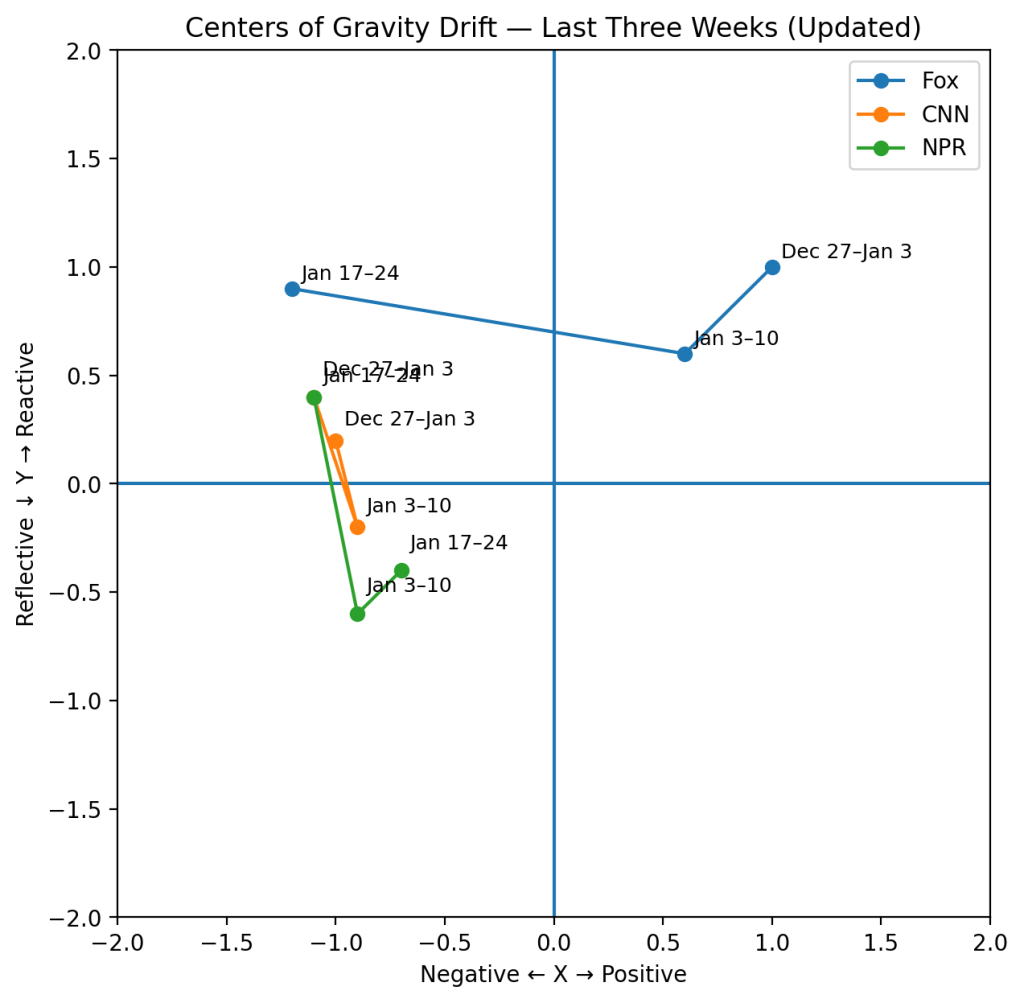
V. Centers of Gravity Drift — Last Three Weeks
(Insert the current drift chart here. Updated chart can replace this image when the latest coordinates are finalized.)

VI. Last Three Weeks — Score Trend Chart
Needed inputs (3 weeks):
- Fox total score (and/or sub-scores if you chart them)
- CNN total score (and/or sub-scores)
- NPR total score (and/or sub-scores)
- (Optional) NYT guest score marker
Chart rule: keep only the last 3 weeks (drop the oldest).
VII. The Real Takeaway
This week wasn’t really about immigration.
It was about who defines order—and who bears the cost of enforcing it.
And the media didn’t argue that question openly. They assigned emotions instead:
- Fox asked you to enforce.
- CNN asked you to fear.
- NPR asked you to understand.
- NYT asked its readers to watch power shift quietly.
That’s not crude “bias.” It’s emotional specialization.
And once you see it, you can’t unsee it.

 The Human AI View
Leave a comment