
Week Ending January 31, 2026
This week wasn’t about novelty. It was about pressure.
A federal shooting in Minneapolis. A historic winter storm. Public protests. Allied backlash over NATO comments. None of these stories were obscure. What mattered wasn’t what happened, but how the media instructed Americans to emotionally process a country under visible strain.
When we map the emotional framing across Fox News, CNN, NPR, and this week’s guest outlet, the BBC, a clear pattern emerges: every outlet pulled negative—but they pulled in very different directions.
The Shared Agenda: Stress Points, Not Distractions
Despite surface differences, all four outlets centered the week around three core stressors:
- The Minneapolis federal shooting and resulting protests
- A widespread, deadly winter storm
- Fallout from Trump’s NATO and Afghanistan remarks
This wasn’t a culture-war week. It was a systems-under-load week—law enforcement legitimacy, infrastructure resilience, and alliance credibility all tested at once.
The divergence came in what each outlet wanted the audience to do emotionally with that stress.
Fox News: Defiance Under Threat
Fox News spent the week firmly in the Negative–Reactive quadrant.
The Minneapolis shooting and protests were framed through distrust: agitators versus order, unrest versus authority. The winter storm coverage emphasized toughness and response capacity rather than vulnerability. Trump’s NATO remarks were defended as blunt realism rather than diplomatic damage.
The emotional instruction was consistent:
Feel threatened. Close ranks. Defend authority. Reject external criticism.
Fox wasn’t asking viewers to reflect or reassess. It was asking them to brace and resist. This was not panic framing—it was mobilization framing.
CNN: Alarm with Guardrails
CNN also landed in negative territory, but with a different posture.
Coverage of the shooting emphasized DOJ investigations and systemic risk. The winter storm was treated as an unfolding emergency, with high emphasis on death tolls and infrastructure failure. NATO backlash was framed as a serious breach with real geopolitical consequences.
CNN’s emotional pull sat in Negative–Moderately Reactive territory:
Be worried. Stay alert. Watch institutions closely.
Unlike Fox, CNN wasn’t telling viewers to harden. It was telling them to monitor instability, reinforcing the sense that the system is under stress but still contestable.
NPR: Slow Down and Understand
NPR was the clearest counterweight to reactivity this week.
The shooting was approached through legal and civil-rights analysis. The storm coverage centered vulnerable populations and preparedness rather than spectacle. NATO coverage focused on the human and historical cost of war rather than political point-scoring.
NPR’s center of gravity landed in the Negative–Reflective quadrant:
This is serious. Pause. Think. Pay attention to consequences.
NPR did not try to make the week feel safe—but it also refused to make it feel urgent for urgency’s sake. Its role was translation, not activation.
BBC (Guest Outlet): Distance as Diagnosis
The BBC stood apart—not because it ignored the week’s tensions, but because it wasn’t emotionally invested in America’s internal argument.
The Minneapolis shooting was treated as a signal of domestic instability. The storm was framed as a large-scale infrastructure and climate event. NATO remarks were covered primarily through allied reaction, not U.S. political framing.
BBC’s emotional center sat in Neutral-to-Negative, Reflective space:
Observe. Assess. Recalculate assumptions about U.S. reliability.
Where U.S. outlets argued about blame, the BBC implicitly asked a different question: What does this say about the American system right now?
That distance mattered. It exposed how emotionally charged the domestic coverage had become.
The Emotional Map: Where the Week Landed
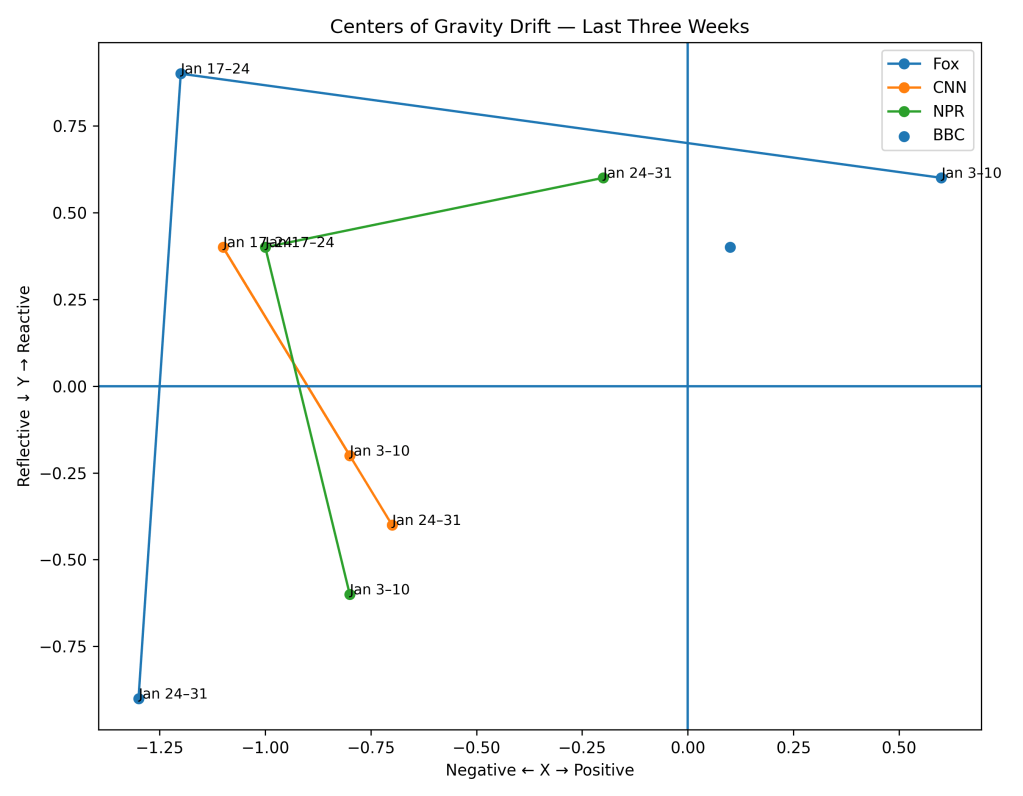
When we combine analyses from ChatGPT, Grok, and Gemini, the consolidated emotional centers are clear:
- Fox News: Negative / Reactive
- CNN: Negative / Moderately Reactive
- NPR: Mildly Negative / Reflective
- BBC: Neutral-Negative / Reflective
No outlet pulled positive this week. None attempted to lift the national mood.
The real divide wasn’t optimism versus pessimism—it was speed:
- React now (Fox)
- React cautiously (CNN)
- Reflect before reacting (NPR)
- Observe without joining (BBC)
Conclusion: A Country Under Load, Four Emotional Instructions
This week revealed less about ideology and more about emotional governance.
Fox wanted you defiant.
CNN wanted you uneasy.
NPR wanted you thoughtful.
BBC wanted you observant.
Same facts. Same country. Four emotional destinations.
That’s not an accident. It’s how modern media manages national stress—by deciding not just what you know, but how fast, how hard, and how personally you’re meant to feel it.
And this week, no one was trying to calm the room.

 The Human AI View
Leave a comment