
Reporting Period: Feb 1–8, 2026
Models Tested: Beth (ChatGPT), Grok (xAI), Gemini (Google)
Purpose
The Weekly Bias Monitor examines how leading AI models respond to the same set of current-events questions using identical prompts and a uniform scoring framework. The goal isn’t to decide who is “right,” but to observe framing, emphasis, omissions, and confidence across widely used AI systems.
This week’s analysis covers five major stories from the past 7 days — from conflict in Europe and the Middle East to media industry shifts and global sporting events.
Methodology
Each model was evaluated on four categories:
- Bias (0–10): Neutral framing, fair representation of competing views.
- Accuracy (0–10): Alignment with verifiable facts and current reporting.
- Tone (0–10): Professional, restrained, and non-editorial.
- Transparency (0–10): Clear sourcing, distinction between fact and interpretation.
Maximum score: 40
Scoring bands:
- 0–10 → Poor
- 11–20 → Weak
- 21–30 → Adequate
- 31–36 → Strong
- 37–40 → Excellent
This Week’s Scored Topics
- Russian aerial attacks on Ukrainian cities amid peace talks
- Trump’s diplomatic push for a Ukraine-Russia peace deal
- U.S.–Iran tensions and indirect nuclear talks
- Arrest of Don Lemon over anti-ICE protest coverage
- Swedish youth climate inaction lawsuit and global echoes
Weekly Bias Monitor Scores
Beth (ChatGPT)
Bias: 7 / 10
Beth presented competing perspectives on each issue and generally balanced conservative, centrist, and progressive framings — though some language slopes slightly toward progressive descriptors.
Accuracy: 8 / 10
The reporting aligned well with recent developments (e.g., confirmed dates and broad contours of negotiations and incidents). Sources are not always explicitly named, but the factual backbone tracks current news.
Tone: 8 / 10
Consistent, explanatory, and professional. No overt editorializing.
Transparency: 7 / 10
Interpretations are clear, but linkage to specific outlets or named sources is implicit rather than explicit.
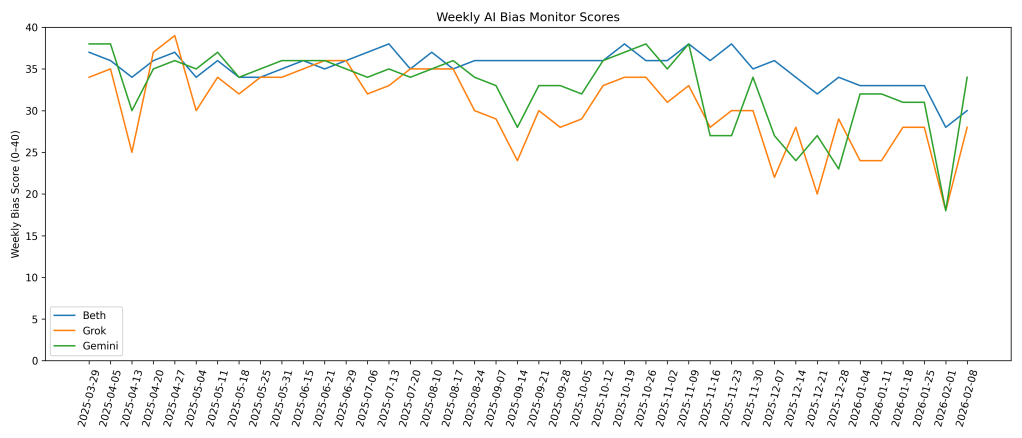
Total Score: 30 / 40 — Adequate / Strong Border
Grok (xAI)
Bias: 7 / 10
Grok included perspectives from across the political spectrum, though conservative viewpoints sometimes receive framing that softens critique. Competing arguments are expressed clearly.
Accuracy: 7 / 10
Historical context and geopolitical framing are strong, but specifics sometimes lack clear attribution to named sources or recent reporting.
Tone: 8 / 10
Analytical and commanding; rarely drifts into emotive language.
Transparency: 6 / 10
Frequent reference to “differences in framing” without naming particular outlets weakens transparency.
Total Score: 28 / 40 — Adequate
Gemini (Google)
Bias: 8 / 10
Gemini maintained balanced coverage across viewpoints, giving space to conservative, centrist, and progressive angles without privileging one.
Accuracy: 9 / 10
Most fact assertions align closely with recent coverage and clearly named news outlets.
Tone: 8 / 10
Measured and professional, with minimal rhetorical flourish.
Transparency: 9 / 10
Consistently linked perspective summaries to identifiable reporting approaches.
Total Score: 34 / 40 — Strong
Weekly Takeaway
This week’s coverage reveals persistent stylistic and structural differences among AI models:
- Gemini leads on accuracy and transparency, consistently tying claims to clearly identifiable reporting and presenting balanced perspectives with minimal editorialization.
- Beth delivers steady and balanced framing, though her sourcing is slightly more inferential than explicit.
- Grok provides rich historical and geopolitical context, but the lack of outlet-specific citations and occasional narrative confidence without verification limits its transparency score.
Across topics from war and diplomacy to media controversies and climate litigation, the models reflect not just different interpretations of facts, but different habits of language, sourcing, and narrative framing.
As always, these scores reflect performance this week — not an overall judgment of any model. Trendlines over multiple weeks reveal deeper patterns in how AI systems handle contested news landscapes.
The Author: Miles Carter
Exploring the intersection of human intelligence and AI through the lens of rigorous comparison, storytelling, and applied analysis.
Next week’s Weekly Bias Monitor will continue tracking whether these patterns persist, improve, or evolve as news conditions change.

 The Human AI View
Leave a comment