
Week Ending February 14, 2026
A conversation with Miles Carter and Beth (ChatGPT) — edits by Grok and Gemini
This week’s news cycle wasn’t defined by a single shock. It was defined by pressure — steady, sustained, and distributed across immigration enforcement, institutional credibility fights, scandal exposure, and public-safety narratives.
The events themselves were not extraordinary. What mattered was emotional framing: the posture each outlet quietly assigned its audience.
This week’s analysis compares Fox News, CNN, NPR, and guest outlet USA Today, focusing not just on facts, but on emotional intent — what each organization wanted its audience to feel, reinforce, or brace for.
Method Note
Headlines were collected using each outlet’s current “recent” and priority story feeds for the week ending February 14, 2026. Where direct homepage capture was inconsistent, Google News “Recent” feeds were used as a standardized comparison proxy.
Emotional scoring and quadrant placement were cross-validated using independent model analysis (ChatGPT, Grok, Gemini) to reduce interpretive bias and maintain week-to-week scoring consistency.
The Week’s Shared Spine
Despite editorial differences, four dominant themes overlapped across outlets:
- The ongoing Nancy Guthrie disappearance investigation
- DHS disruption and immigration enforcement conflict
- Inflation and household economic pressure
- Institutional accountability and elite scandal fallout
These stories formed the emotional backbone of the week: vulnerability, authority, legitimacy, and strain.
How Each Outlet Framed the Week
Fox News — Alert, Then Reassure
Fox framed the week as dangerous but manageable. Missing-person coverage and immigration conflict were delivered with urgency and vigilance. Enforcement posture was emphasized. However, Fox periodically softened the emotional load through cultural and national touchstones.
Emotional posture: Negative and reactive, buffered with reassurance.
Assignment: Stay alert. Trust strength. Maintain confidence.
CNN — Structured Alarm
CNN leaned into institutional friction and political instability. Rather than raw panic, the framing suggested systems under stress — conflict inside government, policy fallout, reputational damage, and governance strain.
Emotional posture: Negative, mixed but leaning reflective.
Assignment: Watch closely. Something is unstable.
NPR — Institutional Unease
NPR avoided spectacle and emphasized credibility, governance process, and long-term impact. Immigration stories centered on legitimacy and consequences rather than enforcement dominance.
Emotional posture: Negative and reflective.
Assignment: Be concerned — but think.
USA Today (Guest) — Practical Stabilizer
USA Today functioned as a pressure valve. While covering the same core stories, its framing focused on impact and service: what it means for travelers, households, or daily routines.
The emotional tone was measured, rarely escalatory.
Emotional posture: Near-neutral to mildly negative, slightly reflective.
Assignment: Stay informed. Keep functioning.
Quadrant Map: Where the Emotional Centers Landed
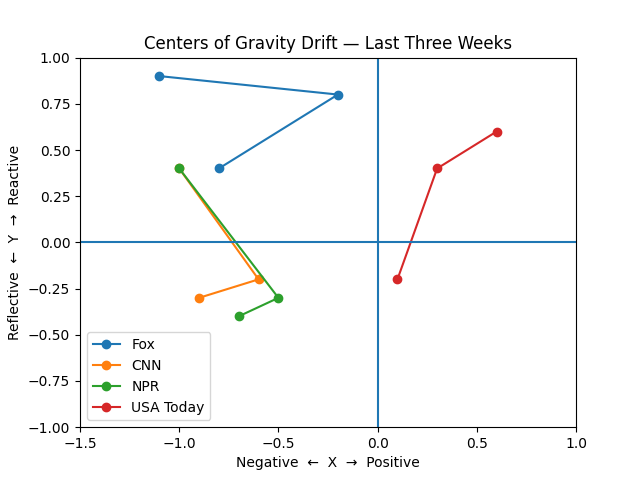
Using consistent emotional scoring (X-axis: Negative → Positive, Y-axis: Reflective → Reactive), the last three weeks show the following drift pattern:

Summary of Current Week Positions
- Fox: Negative + Reactive
- CNN: Negative + Mixed (leaning Reflective)
- NPR: Negative + Reflective
- USA Today: Near-neutral, mildly Reflective
Plain meaning: this was not an optimistic week. Even lighter coverage acted as emotional release, not mood change. Unease dominated. The only difference was whether audiences were instructed to react or reflect.
Non-Overlapping Choices Reveal Strategy
The stories each outlet emphasized beyond the overlap expose emotional intent:
- Fox: Culture friction and enforcement narratives — vigilance reinforcement.
- CNN: Political conflict and accountability — sustained scrutiny.
- NPR: Institutional credibility and governance strain — reflective concern.
- USA Today: Consumer safety, travel, and service reporting — practical stabilization.
These selections were not random. They filled emotional needs for each audience.
The Emotional Assignment
This week produced four distinct roles:
- Fox: Guarded certainty
- CNN: Watchful concern
- NPR: Institutional unease
- USA Today: Practical caution
Same country. Same week. Four emotional realities.
That is the core insight of HWTA: the most powerful product the media delivers is not information — it is how you carry the week forward.

 The Human AI View
Leave a comment