
A conversation with Miles Carter and Beth (ChatGPT) — edits by Grok and Gemini
This week wasn’t about a single explosion. It was about constraint.
Courts stepping in. Power checked. Authority questioned. Enforcement tested. Congress wobbling.
The headlines were procedural. The emotions were not.
We analyzed how Fox News, CNN, NPR, and this week’s guest outlet — Reuters — framed five major stories:
- Supreme Court intervention in a state redistricting case
- Federal court ruling limiting executive tariff authority
- U.S. posture toward Ukraine
- Major immigration enforcement action or deportation ruling
- Congressional leadership conflict or resignation
The facts overlapped. The feelings did not.
1. The Tariff Ruling: Who Controls the Economy?
This was the week’s institutional stress test.
A federal court ruling limited executive tariff authority. That’s dry on paper. But emotionally, it cut straight to a core question: who governs — the presidency or the courts?
Fox News framed the ruling as interference. The emotional tone leaned negative and reactive. The subtext: strong economic policy is being constrained by judges. The posture encouraged: rally, question the court, defend executive leverage.
CNN framed it as guardrails working. Positive and reactive, but in a different direction. The posture encouraged: reassurance that checks and balances still function.
NPR leaned procedural. Reflective, measured, and concerned with long-term precedent rather than immediate outrage.
Reuters remained restrained. Legal reasoning. Market implications. No moral framing.
This story exposed a fundamental divide:
Is judicial constraint stabilizing — or obstructive?
That divide wasn’t about trade policy. It was about constitutional power.
2. Immigration: Order vs Empathy
If tariffs were institutional tension, immigration was emotional voltage.
Fox News emphasized enforcement legitimacy. The framing signaled restoration of order. Positive reactive energy. The audience posture: defend authority, support decisive action.
CNN foregrounded human impact. Negative reactive energy. The audience posture: worry, empathize, scrutinize enforcement methods.
NPR slowed the pace. Negative reflective tone. Focus on due process, legal context, and long-term policy implications.
Reuters stayed procedural. Who ruled. What changed. How many affected.
This was the clearest polarity spike of the week. Identity lines were sharp. Emotional intensity was high across the board.
Immigration remains the most reliable emotional accelerator in American media.
3. Supreme Court and Redistricting: Legitimacy on Trial
Redistricting battles are technical. But the framing revealed deeper stakes.
Fox leaned toward institutional validation — courts correcting imbalance.
CNN leaned toward democratic vigilance — courts influencing representation.
NPR treated it as a legal mechanism within a longer pattern.
Reuters described the procedural movement without narrative escalation.
This story carried moderate intensity, but it reinforced something larger: the judiciary is now a frontline political actor in media storytelling.
4. Ukraine: Strength, Stability, or Risk?
Coverage of U.S. posture toward Ukraine reflected a quieter tension.
Fox signaled recalibration — pragmatic leverage, burden reassessment.
CNN emphasized geopolitical risk and moral consequence.
NPR contextualized diplomacy.
Reuters tracked talks and statements without rhetorical heat.
Ukraine did not generate the week’s highest emotional spike — but it reinforced a consistent split: strategic realism vs moral obligation.
5. Congressional Conflict: Instability Signal
Leadership conflict carried less structural weight but reinforced narrative themes.
Cable outlets treated it as instability theater — urgency, dysfunction, urgency again.
NPR and Reuters treated it as institutional process.
The difference was not in facts. It was in tempo.
The Emotional Map of the Week
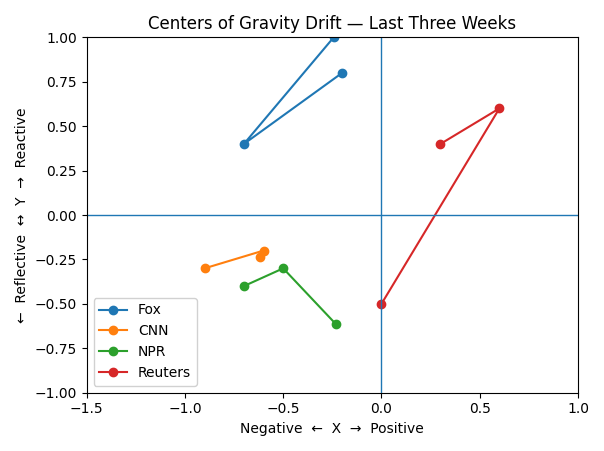
When plotted on the emotional quadrant:
- Fox News drifted toward Positive Reactive on enforcement and redistricting, and Negative Reactive on tariff constraint. The posture: defend sovereignty, question limits.
- CNN leaned Negative Reactive on immigration and institutional tension, Positive Reactive on court checks. The posture: vigilance and accountability.
- NPR held steady in the Negative Reflective quadrant — concern without alarm.
- Reuters anchored near Neutral Reflective — lowest intensity across all five stories.
The structural finding is clear:
Cable news operates in the Reactive half of the emotional spectrum.
Wire services operate in the Reflective center.
NPR sits between them — interpretive but restrained.
So What Did They Want You to Feel?
Fox wanted you to feel defensive strength.
CNN wanted you to feel alert concern.
NPR wanted you to think through consequences.
Reuters wanted you to stay calm.
The week was not about chaos.
It was about control.
Who has it.
Who loses it.
And whether limits are protection — or obstruction.
In 2026, the most powerful emotional story isn’t policy.
It’s authority.

 The Human AI View
Leave a comment