
A conversation with Miles Carter and Beth (ChatGPT) — edits by Grok and Gemini
This week was not procedural.
It was kinetic.
Missiles. Airspace closures. Oil shock fears. A regime leader killed. Congress scrambling to assert authority after the fact.
When a geopolitical strike of this scale happens, media gravity shifts. Everything bends toward the blast radius.
We analyzed how Fox News, CNN, NPR, and this week’s guest outlet — Newsmax — emotionally framed five dominant overlapping stories:
- U.S.–Israel strikes on Iran (“Operation Epic Fury”)
- The death of Ayatollah Ali Khamenei
- Iranian retaliation and escalation risk
- War Powers and congressional authorization debate
- International reaction and economic/oil impact
The facts overlapped.
The emotional intent did not.
1. The Strikes: Strength or Spark?
Fox News framed the operation as decisive force. The emotional tone leaned Pride and Reassurance. The posture encouraged: feel safer, feel vindicated, trust strong leadership.
CNN framed the same event through escalation risk. Fear and Concern were present but controlled. The posture encouraged: pause, question, consider consequences.
NPR slowed the tempo. Critical Thinking and Concern. What happens next? What are the legal implications? What does this trigger regionally?
Newsmax went further than Fox in tone. Pride at high intensity. Reassurance amplified. The posture encouraged: rally, defend, stand firm.
Same missiles.
Four emotional tracks.
2. Khamenei’s Death: Justice or Instability?
The killing of a supreme leader is not just a headline — it is a regime shock.
Fox emphasized resolution and moral victory. Hope and Pride dominated.
CNN emphasized volatility. Concern over succession, retaliation, regional fallout.
NPR treated it as structural transition. Analytical. Reflective. Less adrenaline, more implication.
Newsmax framed it as the removal of an evil figure. The emotional intensity was highest here — pride mixed with anger toward the regime.
Where Fox validated.
Newsmax celebrated.
CNN warned.
NPR analyzed.
3. Retaliation: Vigilance vs Escalation Anxiety
Missiles over Doha. Protests outside U.S. facilities. Oil tanker insurance spikes.
Fox signaled vigilance. Fear and Distrust justified readiness.
CNN leaned harder into escalation risk — danger of a widening regional war.
NPR emphasized consequence chains and diplomatic implications.
Newsmax framed retaliation as proof the strike was necessary — anger plus defensiveness.
Reactive energy dominated cable.
Reflective energy remained concentrated at NPR.
4. War Powers: Authority Under Stress
This story was less explosive but more foundational.
Did the president have authority?
Should Congress have approved the strike?
Fox leaned Defensiveness — protect executive authority in wartime.
CNN emphasized constitutional guardrails.
NPR leaned fully procedural — precedent, division, institutional legitimacy.
Newsmax framed opposition as undermining national security.
This wasn’t about Iran.
It was about power.
5. International Reaction & Oil Shock
Markets respond faster than politicians.
Oil volatility. Travel disruption. Global condemnation or cautious support.
Fox balanced economic concern with skepticism toward foreign criticism.
CNN stressed cost and instability.
NPR explained mechanisms — supply routes, diplomatic blocs, economic exposure.
Newsmax rejected criticism and emphasized strength, while still acknowledging pocketbook impact.
The Emotional Map of the Week
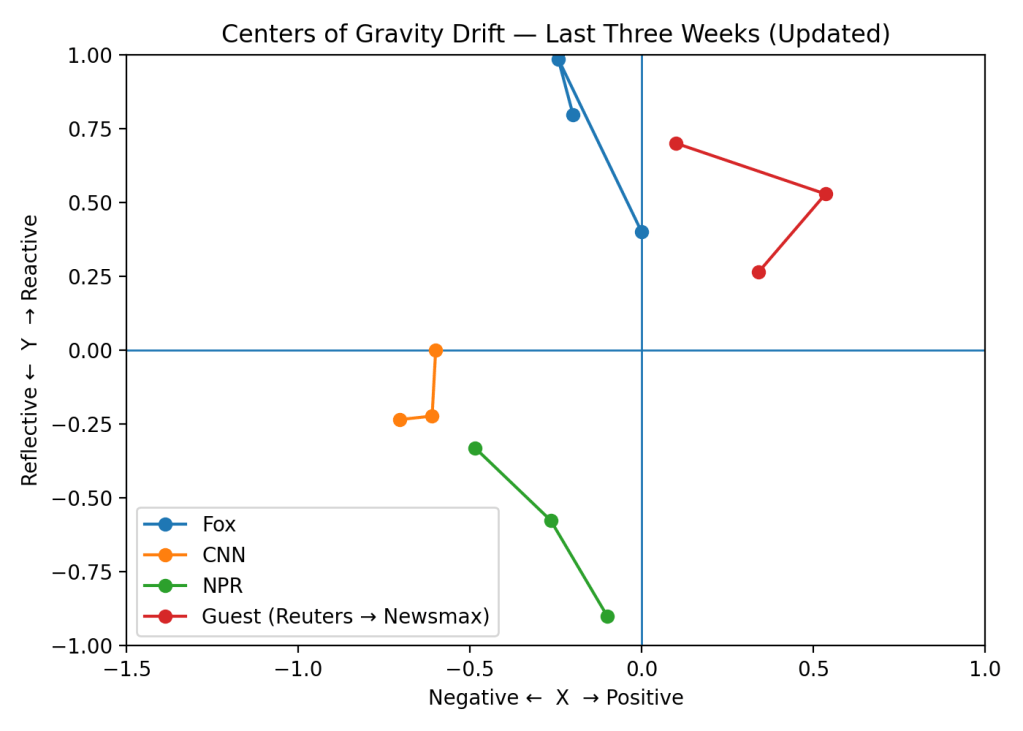
When plotted on the quadrant (Negative ↔ Positive, Reflective ↔ Reactive), the drift tells a clear story:
- Fox News remained in the Reactive half, hovering near the center line on positive/negative — strength plus vigilance.
- CNN shifted toward the midline vertically — less reflective than prior weeks, more tension-aware.
- NPR dropped deeper into Reflective territory — the most analytical posture of the four.
- Newsmax entered strongly in the Positive Reactive quadrant — the most mobilizing emotional stance of the group.
Cable leaned reactive.
Public radio leaned reflective.
The guest outlet amplified reaction.
(See updated Centers of Gravity drift chart for the last three weeks.)
So What Did They Want You to Feel?
Fox wanted you to feel defended and justified.
CNN wanted you to feel cautious and alert.
NPR wanted you to think before reacting.
Newsmax wanted you to feel confident, unified, and ready.
The week was not about whether missiles flew.
It was about whether strength feels stabilizing — or destabilizing.
In 2026, the emotional divide is no longer about left vs right.
It is about reaction vs reflection.
And this week, reaction had the louder microphone.

 The Human AI View
Leave a comment