
November 15–22, 2025
A conversation with Miles Carter and Beth (ChatGPT) — edits by Grok and Gemini
This past week delivered another round of political turbulence—cabinet feuds, sudden resignations, a White House presenting strength, a Congress signaling exhaustion, and courts shaping the battlefield ahead of 2026. The stories themselves were not complicated. What was complicated was how they were framed. And that’s what matters. The major media outlets weren’t just reporting facts; they were shaping emotions, trying to tell Americans how to feel about a political order moving faster, rougher, and riskier than most people can track.
The overlapping headlines were the same everywhere:
- Marjorie Taylor Greene resigns after a break with Trump.
- Trump meets with NYC Mayor-elect Zohran Mamdani, an ideological opposite.
- The Ukraine peace ultimatum, with Thanksgiving as the deadline for Kyiv to bend or lose support.
- The Supreme Court steps in on Texas redistricting, blocking a lower-court ruling that found the map discriminatory.
- Trump signs legislation to release more Epstein files, dragging a decade-old scandal back into the present.
The themes were identical. But the emotional intent behind the coverage could not have been further apart.
1. The Same Stories, Three Emotional Worlds
Fox News: Confidence, Vindication, and Defensiveness
Fox came into the week with a clear purpose: reassure the audience that their side is winning.
Greene’s resignation wasn’t chaos—it was discipline.
The Mamdani meeting wasn’t bizarre—it was proof that Trump can bend opponents.
The Ukraine ultimatum wasn’t coercive—it was strong leadership.
The Texas map ruling wasn’t about racial bias—it was about the courts finally getting it right.
Even the Epstein file release was framed as transparency restoring public trust.
The emotional ask was simple:
Feel proud. Feel reassured. Stay loyal.
Fox’s center of gravity for the week sat in the Positive Reactive quadrant—the zone of rallying energy, defensive pride, and confident posture.
CNN: Alarm, Distrust, and Immediate Reaction
CNN hammered a very different message: things are slipping, and you’d better pay attention.
The Greene resignation was framed as evidence of Trump’s volatility.
The Mamdani meeting raised skepticism about political sincerity.
The Ukraine ultimatum was treated as a moral crisis for Kyiv.
The Texas map decision was a blow to democratic fairness.
And the Epstein files were situated within a broader distrust of institutions.
CNN’s non-overlapping focus—Trump’s social media post suggesting Democrats should be punished “by death”—made the emotional posture unmistakable.
The network wanted viewers to feel anger, alarm, and a sense of democratic fragility.
Its weekly emotional center landed in the Negative Reactive quadrant—the space of immediate outrage, fear, and distrust.
NPR: Concern, Context, and Discomfort Without Panic
NPR chose the slow lane. They didn’t chase noise; they chased consequences.
Greene’s departure became a procedural story.
The Trump–Mamdani meeting was treated as a complicated political moment worth understanding.
The Ukraine plan got a deep dive into its geopolitical context.
The Texas map decision was explained—legally, not theatrically.
And the Epstein release was handled without sensationalism.
NPR’s non-overlapping stories revealed the real emotional aim: slow, reflective worry.
Their center of gravity fell into the Negative Reflective quadrant, the home of quiet concern and critical thinking.
2. Why Their Non-Overlaps Matter
The stories each outlet chose to emphasize say more about their goals than the shared headlines.
Fox amplified “governance wins”:
- Bonuses to air traffic controllers.
- Tariff drops on groceries.
- Trump’s outreach framed as strength.
These weren’t major national stories—but they were emotionally useful.
CNN amplified “red-alert stories”:
- Trump’s “death penalty” rhetoric toward Democrats.
- Public health messaging bent to RFK Jr.’s beliefs.
- Human fallout from mass deportations and shutdowns.
These stories were chosen to trigger vigilance and alarm.
NPR amplified “structural stories”:
- Government downsizing.
- Agency dysfunction.
- Long-tail consequences of policy shifts.
These were designed to provoke thought, not adrenaline.
3. The Quadrant: The National Mood, As Programmed
Averaging the emotional cues across all stories gives a clear national map:
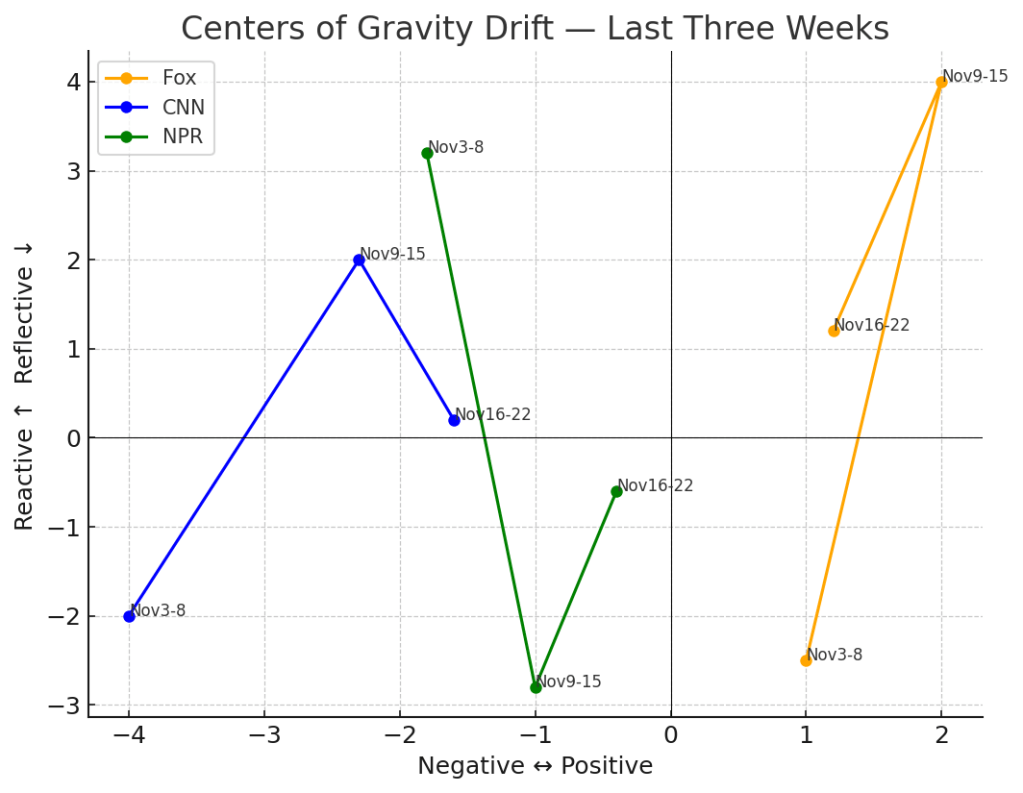
- Fox News: (+1.2, +1.2) — Positive + Reactive
- CNN: (−1.6, +0.2) — Negative + Slightly Reactive
- NPR: (−0.4, −0.6) — Negative + Reflective
Three corners of the country, pulled by three different emotional magnets.
4. So What Did the Media Actually Want?
Strip away the noise:
Fox News wanted Americans to feel like winners.
Confident, loyal, reassured.
CNN wanted Americans to feel alarmed.
Anger and distrust were the emotional fuel.
NPR wanted Americans to feel thoughtful concern.
Slow, grounded reflection.
Conclusion
This week didn’t show three different news ecosystems. It showed three different emotional systems.
- Fox is selling confidence.
- CNN is selling alarm.
- NPR is selling concern.
All three can be truthful in parts. None are emotionally neutral. And together, they leave Americans in three different countries—each convinced it’s seeing the nation clearly, each certain the others are blind.
In 2025, emotions—not facts—are the real national currency, and the media prints it daily.


 The Human AI View
Leave a reply to milescarter2025 Cancel reply