
Weekly Emotional Framing Analysis
The Same Headlines, Four Different Americas
The facts overlapped this week. The feelings did not.
Week ending May 30, 2026 · Reviewed by Grok, Gemini & Claude
Teaser: Four outlets covered the same Iran deal, the same inflation number, and the same Epstein testimony, and sent their audiences home feeling like they live in four different countries.
The headlines changed this week, but the underlying pattern did not. The major outlets covered many of the same events and guided their audiences toward very different emotional conclusions. The shared spine was clear: the tentative US-Iran ceasefire deal and the fight over reopening the Strait of Hormuz; April inflation hitting a three-year high while household savings fell; former Attorney General Pam Bondi’s closed-door Epstein testimony; the Blue Origin rocket explosion; and the Texas Senate runoff that ended with Ken Paxton beating John Cornyn. The facts were largely shared. The emotions were not.
The Mechanism
Selection and framing are doing the work, not invention. Every outlet can run the same true inflation figure and the same true ceasefire update. What differs is which fact leads, which quote survives the edit, and what feeling the package is built to leave behind. The events were constant. The feeling was manufactured.
Fox News: strength under siege. Fox spent much of the week telling a story about threat and control. Iran was framed as leverage in Trump’s hands. The Texas runoff became proof of his continuing grip on the party. The Newark immigration clashes were framed around agents being assaulted, with protesters cast as a hostile mob. Even stories that might create uncertainty were presented through confidence. The message: America faces enemies, but strong leadership is winning. Notably, the inflation story that led elsewhere was largely absent here. The audience was steered toward anger at domestic opponents and reassurance about its own side.
CNN: vigilance and warning signs. CNN leaned into instability. The Iran ceasefire was “messy” and “fragile.” Inflation was paired directly with a record-low savings rate, pointing at the squeeze on households. The Blue Origin explosion read as a setback. The thread was caution. The message: pay attention, things may be more fragile than they look.
NPR: context and consequences. NPR took the same week and asked why. Its Iran framing put the contradiction front and center, bombing and negotiating at the same time, summed up in its own blunt question, “what gives?” Its inflation segment was a history of who actually pays. The tone was analytical rather than alarmed. The message: slow down and understand what this means over time.
The clearest NPR-only story this week was one the others did not lead with at all. NPR reported that the Justice Department had quietly deleted its own news releases documenting Jan. 6 prosecutions, including cases of rioters who assaulted police, while NPR kept its independent database of the same cases online. The DOJ defended the removal as stripping out “partisan propaganda.” NPR framed it as an attempt to erase the public record of accountability. That is the systems story in miniature: the record itself was the off-ramp, and it is being dismantled while one newsroom holds the copy.
CBS News: the human impact. CBS kept returning to ordinary people. Inflation was a family-budget story, anchored by Trump’s line that he does not think about Americans’ finances “not even a little bit” when weighing the war, set against a poll showing just 27 percent approve of his handling of inflation. The heckled-Bondi framing centered abuse survivors. The message: these events matter because they land on real people.
What They Chose to Emphasize
Fox elevated strength, security, and cultural-identity stories. CNN emphasized institutional accountability and warning signs. NPR gave room to policy mechanics and civic structures, and was alone in reporting the DOJ’s deletion of its own Jan. 6 prosecution records. CBS stayed on practical impact and everyday consequences. The editorial choices, not the facts, explain why four audiences came away with four different countries.
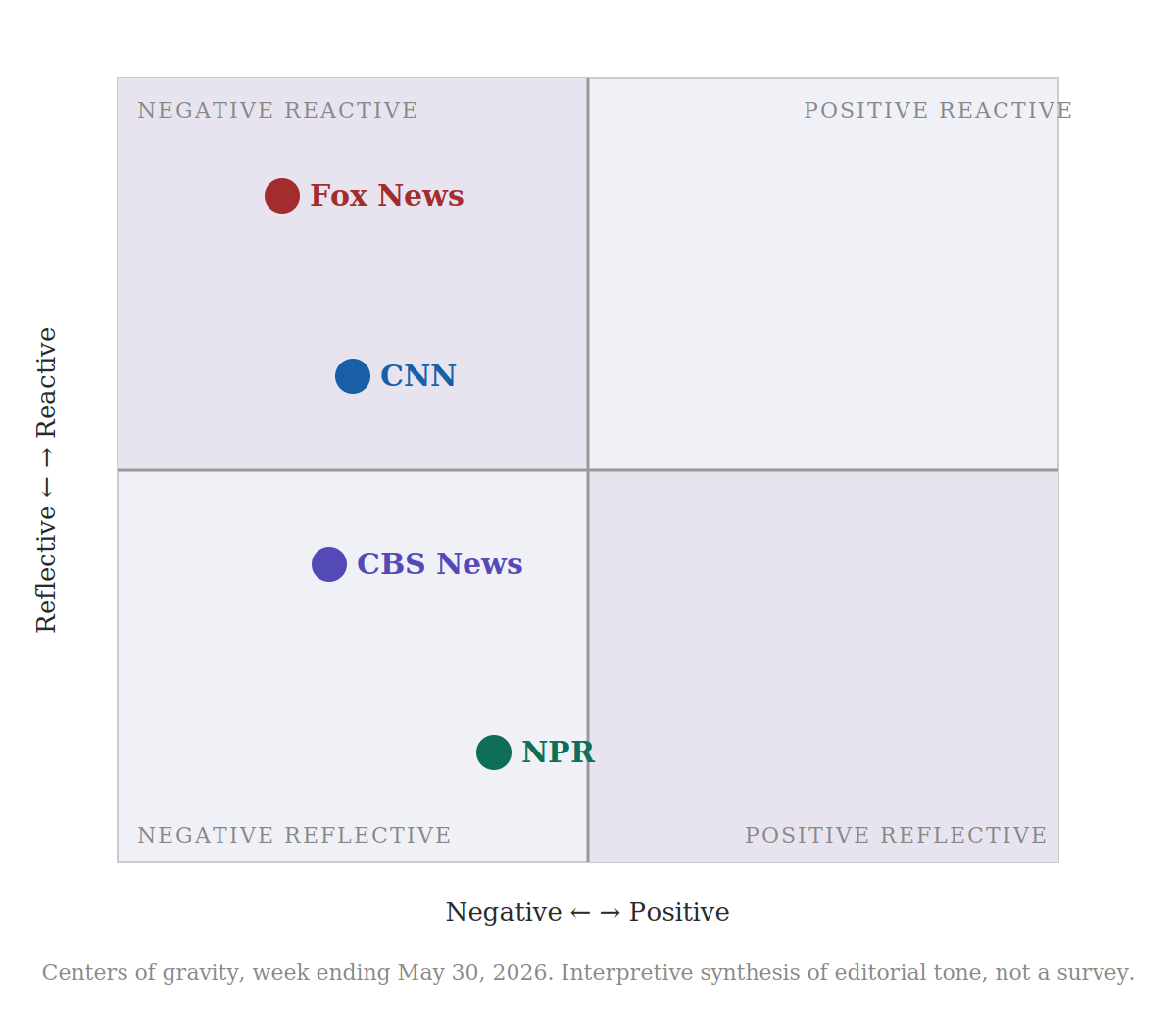
Plotting the week’s dominant emotional load on two axes makes the split visible. The horizontal axis runs from negative to positive feeling. The vertical axis runs from reactive at the top to reflective at the bottom. Each outlet’s marker is its center of gravity across its top stories.
Where Each Outlet Landed
Fox sits deepest in Negative Reactive, anger and distrust pointed outward at protesters and judges, with reassurance reserved for its own side. CNN sits in Negative Reactive but nearer center, concern tipping into anxiety. CBS sits in Negative Reflective, empathy and quiet distrust. NPR sits furthest into Neutral and Reflective, critical thinking over alarm. One outlet is furious, one is anxious, one is detached, one is worried for its neighbors.
What each outlet wanted its audience to feel. Fox wanted viewers to feel that strong leadership was defending the country and winning, and that critics were overstating the danger. CNN wanted viewers alert and watchful, tracking institutional and geopolitical strain. NPR wanted listeners thoughtful and concerned, attuned to accountability, public records, and long-term cost. CBS wanted viewers informed and grounded, aware of real risk without being pushed toward outrage.
The facts overlapped. The emotions did not. A Fox viewer saw a nation defending itself and winning. A CNN viewer saw a nation navigating dangerous uncertainty. An NPR listener saw a nation working through questions of accountability and cost, including a record being erased in real time. A CBS viewer saw a nation whose decisions land hardest on families, workers, and survivors. Same week, same headlines, four different Americas. As this project keeps finding, emotion, not fact, is the most powerful tool any outlet has for shaping how its audience understands the world.
The Test
If a single inflation report can be turned into vindication, alarm, an explainer, and a family hardship story in the same week, the question is not which outlet is lying. None of them have to. The question is what you were left feeling, and who benefited from you feeling it.
Sources & Notes
1. CNN, “US and Iran reach tentative agreement though Trump hasn’t signed off on it,” May 28, 2026.
2. CNN, “5 things to know for May 29: Rocket explodes, Potential deal, Inflation,” May 29, 2026.
3. CBS News, Inflation coverage and Trump “not even a little bit” remarks, May 2026.
4. CBS News, Trump second-term approval at 27 percent on inflation (CBS News poll), May 2026.
5. CBS News, Bondi heckled by Epstein survivors before closed-door Oversight testimony, May 29, 2026.
6. NPR, National and World sections, Iran strikes-amid-talks coverage and inflation explainer, May 28-29, 2026.
7. NPR, Texas runoff (Paxton defeats Cornyn), May 26, 2026.
8. Fox News, May 29 article index and video page, Newark/Delaney Hall ICE clashes and Iran coverage, May 29, 2026.
9. NPR (Tom Dreisbach), “Trump DOJ mass-deletes info on Jan. 6 riot cases, including violent assaults on cops,” May 26, 2026.
10. Note: Quadrant placements are an interpretive synthesis of editorial framing and emotional load, not a measured survey. Scoring assesses tone, not factual accuracy.


Leave a Reply